You're dangerously close to making the leap I made a while ago which is horrifically un-PC. I'm going to say this and hope HN can appreciate the point of view even if they don't agree.
A fundamental problem with wealth redistribution as practised by governments (and credit card companies) is it makes the easiest route to riches taking advantage of people of . . . not necessarily the greatest ability to manage their finances responsibly. This means an enormous proportion of the smartest people in the western world are engaged in attempting to extract cash from people they are essentially exploiting, which ends up costing society as a whole since those people should be actively employed doing things which are more valuable.
You can't regulate taking advantage of stupidity out of the market, so the only answer is to come up with a redistribution mechanism that doesn't create such giant holes.
I did a contract a few years ago for a startup 'gaming' company. They were extracting cash out of people for plays in their games I.e. you buy credit and throw that into nonrefundable plays. In the end if you built up enough virtual credits, you could trade them for expensive consumer electronics.
I was hired to fix their infrastructure.
Well it turns out most of their infrastructure was used to create fake players that these people were pitted against. The odds were fixed and the fake players win nearly every time. Occasionally they'd send someone a MacBook or something by pulling a number from a hat. They were fixed so short term wins were possible but it tailed off in the form 1-e^x.
So basically they were forcing people to toil with no return.
This crossed my ethical limit, so I reported this to ASA (Im in the UK too) and trading standards and immediately quit. The company scurried away with no one ever to be seen again. Turns out their op was running from Gibraltar and everyone was dodgy.
A couple of weeks later I got a narky letter threatening to sue me big time, so I wrote a 'fuck you assholes' reply and folded my limited company and started another one.
If any of the assholes, and you know who you are, are reading this, I'm still armed to deal with your shit.
I was tempted to make a similar game infrastructure design decision recently, namely, faking players in game highly dependant on reaching critical volume of players, in attempt to alleviate problem of players waiting too long for their next opponent.
I, of course, said 'no' to myself, and then tried to work around it, and [some technical difficulties ommited] we now have awesome feature presented as Special Encounter where players play against NPCs, but still weighed similarly to plays against real players.
Being plain evil is easy way out, with higher risk assigned to those decisions. But somewhere in the problem-solution space, there's an ethical solution begging to be found, frequently better performant than the obvious evil one.
Unrelated, how long did it took you to fold a company? It's a lengthy and painful process here, even if you're profitable and without debts to anyone.
Fake players are not necessarily a bad thing. You don't have to program them to fix the game as the company pling worked for did. You can make them perform as average players or even weak ones (so you have many winning and happy real players). You decided to openly advertise them as NPCs and that's ok but you might have just hinted about their nature. Plenty of games have bots and NPCs. Actually, up to the time of Internet games everybody played against bots all the time and the end level bosses were usually very strong. Nobody complained (too much) about it.
As long as you mark fake players as such, I don't think anyone will complain. The problem is when you present bots as real player. At this point you're just lying to people.
This presentation works better, as it looks like a feature, not a "hack". Also, I don't really agree that winning players are neccesarily happy players. We took special care for bots to match very closely player's skill level so it leads to intense games, instead of wins.
>You can't regulate taking advantage of stupidity out of the market
While you are right that it cant be prevented, it can be made a lot harder using regulation (starting by having strict verifiable truth requirements in advertising and marketing).
The problem is those people are often so focused on actually creating real value: professors, doctors, etc. All well known to be lousy at managing their finances. The system rewards those who are spending their time creating NO value taking advantage of those who are so busy creating REAL value. Obviously this has completely gone beyond the scope of this ASA, but it's a fundamental truth about the finance industry.
Wealth redistribution as practiced through government doesn't hands giant wads of cash over to poor people that lay around waiting to be targetted by scammers. The redistrubtive mechanisms are almost always free or heavily subsidised services - education, health care, etc.
1. Apps are generally made by wealthy, well-off people.
2. For many apps, the goal is to create an experience that satiates the addictive urges of people with poor impulse control. These people often turn out to be less well-off, possibly because they have poor impulse control.
3. Because money is going from the less-well-off to the well-off, wealth is being redistributed.
Is there evidence that people who compulsively play games like this are less well-off? My understanding of the profit model of these games is that they hope to extract large quantities of money from a small population of obsessives ("whales"), bolstered by a small amount of money from the otherwise vast majority of non-obsessive players.
There's not a whole lot of research on these people, but I don't know of any evidence that they tend to be poor, while there is definitely anecdotal evidence some of them are extremely well-off ($200k+ salaries [1]).
I do wonder about the thinking of people who make games like this. I mean when the business model is about getting your customers literally addicted and there's no benefit besides "it's fun" (questionably), I don't see how it's particularly different from designing slot machines. I did find a blog that discusses that perspective in more detail:
https://drmarkgriffiths.wordpress.com/tag/slot-machine-addic...
The gamasutra article starts with a disturbing description of someone addicted to TF2.
Team Fortress 2 is often described as IAP done right - purely cosmetic items that confer no gameplay advantage. So it's useful to see that even that can exploit vulnerable people.
Should game makes pit protective measures in place? Or at least have a process that allows players to self-report their vulnerability?
A better system might be mandated savings. This is not redistribution, so the only cost is enforcing the scheme. Australia has this in the form of compulsory superannuation, and Singapore has it in the form of the Central Provident Fund. This prevents people with poor self control from squandering all their income. It also contributes to overall economic growth, by increasing the national savings rate and hence increasing the amount that can be invested.
Note that the American Social Security system is not a mandatory savings scheme. The money paid into it is not necessarily saved/invested, and can in fact be spent by the government however it wishes. The amount of money a person receives back from the scheme is also not proportional to the amount they paid in.
>The money paid into it is not necessarily saved/invested, and can in fact be spent by the government however it wishes.
This is not true. The government borrows from the fund, and leaves treasury bonds in it. If you personally save your money in treasuries, it's still considered savings. This is not different.
>The amount of money a person receives back from the scheme is also not proportional to the amount they paid in.
Why would preserving wealth differences be important to a forced savings scheme?
>The government borrows from the fund, and leaves treasury bonds in it. If you personally save your money in treasuries, it's still considered savings. This is not different.
We're using a different definition of savings. I mean savings as in not-consuming. By this sense, investing in treasuries is only 'saving' in the grander scale if the government doesn't spend the money, or if it invests it. If the government uses it for consumption or in transfer payments to people who then use it for consumption, it's ultimately not 'saved', it's consumed. This means that when the original saver gets the money back, they're not getting the money they saved, they're actually receiving a transfer payment, as the money (value) they saved no longer exists.
This is why American social security could potentially "run dry"[1], which wouldn't happen in a system where people only got back exactly what they put in (plus interest) and the money wasn't used for anything else.
>Why would preserving wealth differences be important to a forced savings scheme?
If you're not 'preserving wealth differences', you're transferring money to people who didn't originally earn it. This makes it a transfer scheme, not necessarily a savings scheme. The parent seemed to be looking for alternatives to transfer schemes.
> You can't regulate taking advantage of stupidity out of the market, so the only answer is to come up with a redistribution mechanism that doesn't create such giant holes.
But what do you propose for that? Because in the world we live in, all attempts at some form of "wealth equality" led to either disaster or technological crippling.
Maybe there's an ideal solution. It's probably something you could even prove mathematically. But even then, it is not a solution that will happen in at least several generations; and in the mean time, behaviour like EA's is doing nothing but steal opportunities (when you indebt someone, you can ruin or severely cripple their entire life and sometimes their families') in order to pay for the CEOs' jacuzzis.
But what do you propose for that? Because in the world we live in, all attempts at some form of "wealth equality" led to either disaster or technological crippling.
Really? Progressive taxes and income tests for benefits have let to disaster and technological crippling?
More likely, the only attempts at "wealth equality" that you pay attention to are the ones that fail.
Well, indeed. I'm far from convinced there are easy solutions to the problem, and in my more conservative moments I can entertain the idea of abolishing even pretences at welfare aimed redistribution on this basis, but ultimately it's very hard to stomach. Credit should probably be harder to obtain, regardless of the position I'm feeling in at the time!
Ironically the better approach may be fairly close to what's in the games, and that is to expand the scope of food stamps (or similar) to create a sort of two tiered currency setup, where one currency is only legally usable for basic needs. Unfortunately that's likely to have exactly the same consequences as exists in the games.
Give it a year or so, and credit will be much harder to obtain. Problem will solve itself, with massive consequences for the rest of us.
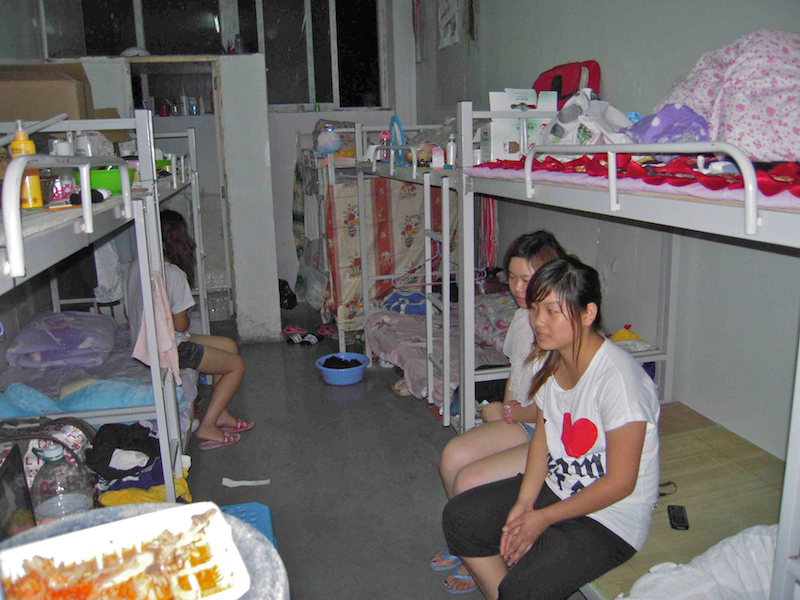
Problem is that we simply don't have economically useful things for people to do. This problem is hitting China. Unemployment is hitting people who are willing to tolerate this quality of life :
It's being caused partially by the energy crunch (even with the US shale boom, net oil available to the world to use has been declining since 2005) and the lack of solutions (note that solar panels need ... a lot of oil to get produced, wind turbines need massive amounts of oil for their production, so so far the whole "renewable" energy thing has increased, not decreased, our reliance on oil. Hopefully that'll reverse in a decade or so, question is will it still matter by then ? Also global warming policies have basically moved a lot of factories which were in the west (where they were powered by mostly oil, some nuclear, little bit of gas), to China (where they are powered by coal). Coal is about 10x worse for the environment than coal).
But fixing the oil problem (e.g. there are massive methane deposits along continental edges that could replace natural gas. They're big enough that they put the total amount of oil available in 1950 to shame. We don't currently know how to extract them, but loads (as in dozens) of research programs are in progress to fix that) would not bring a permanent solution.
What we need is something useful for unskilled workers to do that is reasonably well-paid, can use any amount of unskilled workers, is spread about the country, and ideally cheaper than bailing out banks. Maybe we ought to take a page out of the Roman empire's book and start building cathedrals in every city in America ? Worked for Europe for several hundred years ...
It figures it will be paid by 2020 at the latest (it also figures that current solar pv energy production matches or exceeds energy consumption by panel producers).
That still means that the energy balance is negative until that time.
Also : There's caveats in this study. They are calculating the point where PV electricity production starts exceeding energy use in PV production, assuming no rise from current production levels. This is not a good guide to use to decide whether a specific installation of PV is a net-energy-negative or not. Any small-scale installation north of, say, Detroit, will never be energy positive, and is just a loss. This includes most of the German installed base.
I was putting forth a credible resource that pretty much exactly addressed the topic, not trying to argue with what you said.
I guess a useful government regulation would be to require estimates of the energy consumed to make certain energy products available. It would be pretty much impossible to do at the point of sale for things like retail gasoline, but a given fuel distributor shouldn't have too much trouble calculating their average for some period of time (especially if they are getting reasonable numbers from upstream providers).
I talk about gasoline because I think it would be interesting to have numbers for more than just solar panels and liquid fuels are probably one of the more complicated places to do such a calculation. It should be relatively easy for pv manufacturers.
Why do you think that people should have to do 'economically useful' things?
Surely it is one of the goals of technology and progress that we free people from the need to work. As such, any step towards this 'leisure economy' should be celebrated, rather than thinking up pointless labour for people to do.
I suspect that, without some sort of direction, many people would go mad. It would be nice if people used their leisure time to create art or pursue research of some sort and so on, but people generally don't. You see it all the time, lottery winners who are miserable, some of them even going back to their ordinary jobs, because they miss them. For every JK Rowling who spent a period of unemployment writing a book, there are a million who won't even read a book. There's no easy way around this, it needs a fairly basic shift in human nature.
I'd be just fine. The natural state of man isn't a 40-hour workweek, and it wasn't even common until the industrial revolution. Hunter-gatherers worked less than we do.
If people still feel too idle and can't come up with something to do on their own, they can share a 40hr job with 4 or 5 other people. I am fully confident, though, that everyone will find something they like to do to occupy their time.
Quote:life expectancy at age 15 is 48 years for Aborigines, 52 and 51 for settled Ache and !Kung, yet 31 and 36 for peas-
ant and transitional Agta.
Survival to age 45 varies between 19 and 54 percent, and those aged 45 live an average of 12–24 additional years
The modal age of mortality in hunter-gatherers can range from 68 in the Hiwi to 78 in the Tsimane.
The "natural state of man" is to work from sunrise to sunset to find enough to eat, and still sometimes going to sleep hungry. The hunter-gatherer lifestyle wore people out so they died at 30! The natural state of humans is to be active. The question in the modern world is what activity.
Incidentally, my experience of job sharing is that it doesn't scale. You get 2 or 3 people, they arrange the job share among themselves, everyone is blissfully happy. Then one leaves and how do you fill the position, when it was tailored for one specific individual's lifestyle? The other sharers then find themselves having to adapt again, and maybe that's incompatible with the other commitments they've picked up thanks to the arrangement. 9-5 is actually the least-worst option all things considered.
Work is of two kinds: first, altering the position of matter at or near the earth's surface relatively to other such matter; second, telling other people to do so
Well for a start that isn't true... And JK Rowling is a perfect example of it.
Automated food production at the municpal level, tax funded. You solve a whole lot of other problems at the same time.
There's a lot of understandable barriers to implementing that, but it's the only reasonable path I see. Guaranteed minimum wage is fundamentally broken, because cash is not an innately useful resource. Food is.
Soylent highlights the path to solving the regulation nightmare that surrounds agriculture. It's a hell of a lot easier to verify a soylent mixture is to spec, and the processes that created it, than it is to verify agriculture.
Soon the miracle of rocks to bread will be as ordinary as instantaneous global communication.
I don't think you deserve those downvotes you seem to be getting. You're raising some interesting points worth further discussion, even though I don't agree with the concept of switching from normal food to soylent; it's not the world I'd like to live in (though it surely simplify food regulations).
> Soon the miracle of rocks to bread will be as ordinary as instantaneous global communication.
I'm really looking forward to it, it needs to be done sooner than later, or we're screwed.


A fundamental problem with wealth redistribution as practised by governments (and credit card companies) is it makes the easiest route to riches taking advantage of people of . . . not necessarily the greatest ability to manage their finances responsibly. This means an enormous proportion of the smartest people in the western world are engaged in attempting to extract cash from people they are essentially exploiting, which ends up costing society as a whole since those people should be actively employed doing things which are more valuable.
You can't regulate taking advantage of stupidity out of the market, so the only answer is to come up with a redistribution mechanism that doesn't create such giant holes.