Image stacking to remove noise and optical artifacts, careful use of color filters to enhance contrast and pull out detail. The press release says it used Red: F444W, Orange: F335M, Yellow: F470N, Green: F200W, Cyan: F187N, Blue: F090W. The N filters are narrowband. F470N is only 54 nanometers wide: https://jwst-docs.stsci.edu/jwst-near-infrared-camera/nircam...
Almost all the light in this image is way off the red end of the human visual spectrum, of course. The shortest wavelength filter is F090W which has a center wavelength of 902nm, about the same color as the light coming out of a TV remote infrared LED, which is barely visible in pure darkness.
This is what it looks like through a film SLR, without the detail enhancing filters: http://www.phys.ttu.edu/~ozprof/3372f.htm Here's a 20 minute exposure through a telescope: http://www.phys.ttu.edu/~ozprof/3372fk.jpg Maybe what you would see with your own eyes through binoculars at a dark site well away from city lights. A dim red smudge, hints of finer detail.
While the JWST uses the red end of the human visual spectrum and narrow filters these objects are still broadband and can be imaged as such. Adam did an excellent job on widefield https://www.adamblockphotos.com/ngc-3372-carina-nebula.html and there are lots of deep field images in RGB on Astro imaging sites. The detail is phenomenal with JWST but a lot of people are saying one wouldn't see this with their eyes or with a color cam - and they're "wrong" (its complex). Your eyes just don't "collect" photons like a camera, but a color camera would see this nebula beautifully... We use NB in hobby Astro imaging a lot just to reduce the impact of light pollution.
NGC3372 is inside our galaxy, just 8500 light years away. It's not redshifted by metric expansion to any appreciable degree, (A calculator I just checked gave me a z of 0.000000617) and radial velocity is a sedate ~34 km/s. (z = 0.000000115)
The redshift on the other JWST images is because most of them are of objects that are much, much, much farther away. Infrared telescopes are great for observing those, but that's not the only thing they're used for.
Maybe my question would be better asked for other objects images then, but I can just google how far things are redshifted at extreme distances as well.
Redshift refers to how the wavelength of a photon can change if the observer is moving relative to it, (Doppler shift, redshift if you're moving away from the photon, blueshift if you're moving towards it) or cosmological redshift. (The fabric of the universe expanding, reducing photon energy)
NGC3372 is a cloud of (relatively) hot gas and dust. It's emitting broad spectrum blackbody radiation: it's emitting on all wavelengths. You can look at the same cloud at different wavelengths and see different things, telling you what parts of the cloud are at what temperature, or relative chemical composition, or what parts are ionized: http://legacy.spitzer.caltech.edu/uploaded_files/graphics/fu... Nothing here is redshifted, Spitzer is just capturing different light entirely.
Ok, disclaimer: I am not an astronomer and this might all be rubbish. I suspect I'm neglecting relativistic effects that might be important, for example.
The NIRCAM instrument on JWST has a wavelength range of about 600 - 5000nm [1]. The human eye is sensitive to around 380nm - 700nm.
To shift blue light (380nm) down to the upper frequency range of NIRCAM (600nm) requires a redshift of:
z = Δλ / λ0 = 0.58
This is related to the velocity of the object by:
z = v / c
and the velocity is related to distance (approximately) by the Hubble constant (H0 ~ 71 km/s / Mpc):
d = v/ H0
So we can rearrange and solve for distance to get:
d = z c / H0 = 8 billion light years.
The southern ring nebula is more like 2000 light years from us, so not even vaguely far enough that NIRCAM would see "originally-visible" light. The deep field image might actually be far enough... the faintest galaxies there might be something like 12 billion light years away [2].
Different wavelengths of light scatter more or less as they pass through gas or dust. This is why the Earth's sky is blue on a clear day, and sunsets are red --- the red light scatters less, blue scatters more.
In smokey or smoggy air, the red light is also scattered.
The "smoke" in a nebula is mostly gas and dust. It's either left-over primordeal matter (hydrogen gas, some helium), or ejecta from novas and supernovas --- star-smoke if you will, though it's created by nuclear fusion rather than chemical combustion.
JWST's IR sensors can cut through that dust more readily than Hubble's optical-range sensors could, and pull out more detail on the dust to boot (based on my own viewing of comparative images).
I'm not sure if the dust is reflecting light or glowing from heat, though my hunch is it's mostly reflecting. Stellar gas that gets hot enough will also glow in infrared (or higher) wavelengths, and that might also be picked up by JWST. I suspect there will be targets demonstrating this in future.
It’s real light, just color shifted as the JWST is designed to look at severely very distant and thus red shifted objects. The nebula is however much closer than that.
how does the scale of color shifting relate to the red-shift present in deep-field subject?
Idly wondering: are the furtherest objects being captured, so red-shifted, that the translation for human viewing done in these images more or less balances that out, so what we see in the translated images for some thickness of distance-bubble, is what we would see from a much closer perspective with the naked eye, akin to "true color." (I.e. so close that the relative red-shift would be insignificant...)
It’s not a 1:1 color mapping to correct for red shifting. Each color represents a wavelength, but the mapping is arbitrary and chosen to maximize contrast.
I'm suspecting that there's no hard rule for what colours are assigned to what frequencies, though "more red" in processed images probably corresponds to "longer wavelengths" in captured imaging data. There's no specific red-shift interpretation, though for viewing of distant objects (and galaxies particularly which have reasonably uniform emission spectra) "redder" -> "more distant, receding faster".
What you'd want to see specifically are the emission spectra showing absorption lines for well-known spectral bands. This shows specifically how red-shifted the light is, and is how red-shift was initially detected.
I doubt that there's an intentional mapping of red-shifted appearance + spectral sensitivity to near-and-unadjusted appearance. Though that might be possible.
In practice, I suspect the bands JWST is receiving don't map well to the RGB sensitivity of the human eye, but insteat JWST's sensitivity is tuned to scientific interests and value.
It's all real, but you would not be able to see it with your bare eyes even if you were relatively close to the nebula. The world around us would look very different if our eyes could perceive more of the infrared and ultraviolet spectrum.
The coloring is usually done to indicate different temperatures or wavelengths detected, so it can be a bit misleading.
I'm waiting for https://en.wikipedia.org/wiki/Pillars_of_Creation made by Webb.
It's not the same object, but similarly awesome. Maybe the article gives you an useful overview of how different telescopes 'see', and how that is translated into pictures for us.
These objects are much too faint to see much of anything with human eyes. We can see them in astrophotography because the exposures are hours long (or weeks even, sometimes), and because telescopes gather more light than the eye per unit time, as well. This is why these nebulae look like billowing clouds - they are huge (light years across), so some light is absorbed as it crosses them, and some of the infrared light emitted by them adds up. And then we enhance the effect by taking very long exposures. If we actually went and stood near or even inside these nebulae, we would still be in pretty hard interstellar vacuum, and we wouldn't see anything.
But that's with a telescope and long exposure & image stacking. But still in RGB as humans would see it.
I guess there would be a point that if you were not so far away, but still far enough away - it would light up the sky. This is emission nebula after all.
BUt if you were in it, it would be so diffuse that you wouldn't know it... perhaps a weird glow if you were near some of the forming stars.


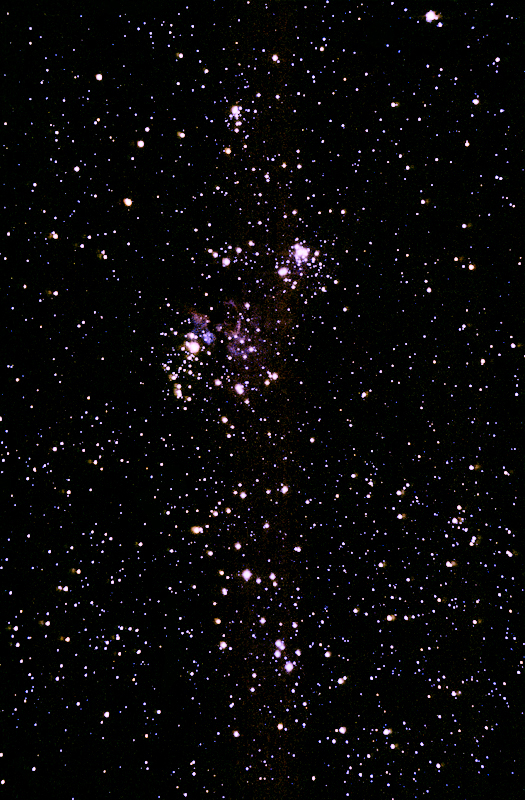

> https://stsci-opo.org/STScI-01G7ETPF7DVBJAC42JR5N6EQRH.png
Is this for real?! It looks like it came right out of a Sci-Fi movie/book. Could anyone explain how much of this is post-editing magic?