It was painfully obvious that nearly nobody wanted to take 8:00 AM classes when I was in college. There were two friends of mine who took the same 8:00 AM math class one semester, and they never met in lecture, except on quiz days.
Even the early birds I knew didn't quite like the morning classes, because they then had to rush towards lecture halls first thing in the morning, rather than strolling leisurely to the library, eating breakfast, or jogging and taking a shower, which I suspect is what many early birds most enjoy about being an early bird.
The problem is that there are seminars and stuff that occur at at like 7 or 8 pm, so university life almost necessarily extends late (after lecture, dinner, assignments, projects) in the evening at least on some days. This is further exacerbated by the fact that given how many group assignments there are, individual student rarely have total control over their own schedule. Even if you carefully choose your classes, avoid all late-night sessions, don't party, plan your life, it's still incredibly hard to sleep before 11pm consistently.
> Even the early birds I knew didn't quite like the morning classes, because they then had to rush towards lecture halls first thing in the morning, rather than strolling leisurely to the library, eating breakfast, or jogging and taking a shower, which I suspect is what many early birds most enjoy about being an early bird.
As an early bird, spot on. I don't like being late or being rushed. I also like surfing with the sun coming up or working out first thing in the morning.
The curious thing about the earliest classes is that they are the ones that tend to fill first. Why? Because its easy for people who handle enrollments.
Hmmm. Section 1 at 7 am? Section 2 at 8am? Section 6 at 1pm? Let's enroll you in section 1 before it fills up so that way we can get you in other classes later.
In fact, there are records systems that do this automatically. Input what classes are needed, and get enrolled in the earliest one. EVERY time. Not really smart.
When I was teaching community college full time, I noticed that the early afternoon students were usually the brightest and most attentive. Most young people really hit their stride in evening classes and could easily go past 10pm. But working adults who came from work usually packed up and left when lab started. They understandably just didn't have the energy.
I don't know how its for other Unis, but YorkU (Toronto) has the Visual Schedule builder that lets you see the schedule and select the section based on the time.
...that said, they have the other extreme of classes ending at 10PM...
When I was at university the lectures started at 9, and everyone knew that not a soul was going to be there for the Monday 9am session, including the lecturer.
"it's still incredibly hard to sleep before 11pm consistently."
I didn't really have that problem. I had one semester that was really had where I would stay up late to do solo projects and coursework. The rest of time it was easy to go to sleep before 11pm. I think the only times that I didn't would have been due to partying, but usually not on a school night.
Not that I saw. I was in computer science. I knew people in education, business, math, physics, etc.
The reason my semester was hard was due to a poor professor and taking advanced classes as a freshman (several 300 levels, including math, which I struggle with).
I do know doctors in residency and others that have rough schedules, but that's not undergrad.
As an MIS undergrad student I had "that 1 semester" where I would work myself delirious. It was not a good time. However that was followed by 3 years of taking the minimum number of hours per semester to maintain scholarship and carefully selected schedules that never again required me to be in a classroom before 2pm.
At first, I was actually surprised by how much faster it was to do schoolwork when not crushed under sleep debt. It turned out only having scheduled classes when I was actually awake made things a lot easier.
> It was painfully obvious that nearly nobody wanted to take 8:00 AM classes when I was in college.
Too right. I, and a number of classmates, got screwed one year by our college when enrollment was a good deal lower than forecast. I had wisely enrolled in a 9AM math class but there was a whole spread of classes by one professor that were under-enrolled so they combined them all into one class.
I'd like to see a more nuanced discussion of what 8am actually is. I've lived in places where 8am means you've already had 2-3 hours of sunlight and places where 8am is pitch black. Clock time and sun time don't always match.
Social time is another aspect, although linked more closely with clock time. After moving countries I found it very strange to see popular TV shows advertised with with a start time of half-past midnight. "Who would be up to watch it?" I thought. Of course, it turns out, there are plenty of people up watching TV at that time in this culture.
Commute time is huge as well. I went to a University that had double to triple the amount of undergrads to parking spots. The student's time was a total afterthought.
An 8am class would be showing up at 6-7 to find parking and get to the classroom. Disgusting, I never took courses that required regular attendance there for that reason.
There's so many compounding variables that emerge from Universities total neglect of prioritizing learning. I don't think its as simple as early=bad.
This is an excellent point, but I have to tell you that it gets worse at the middle of the day because 8am courses are taken by a self-selecting group of students ("I want the 8am" and "I didn't start registering until the last minute"). The parking issue picks up at 10 am and nobody can find a spot - I drive around the faculty lots for 15 minutes on my MWF semesters and emerge at 5 pm to find everybody gone (as you'd expect). By 11 students are parked on top of berms, in staff spots (a ticket? the price of doing business), in motorcycle spots, everywhere. My course meetings start for real 5 minutes after posted time; it's all warmup for those in dorms who get there at the hour.
You're absolutely correct. I was focusing on the post, but if your class is at 3pm you have to show up at like 8-10am or something ridiculous to get a spot.
If the school has overbooked students:parking then its a scam to offer parking permits to students who probabilistically will never find a parking spot without resorting to the extremes (time or distance). There's no reason to offer a permit (or charge for it).
I don't think its because of cars. There wont ever be a high quality uni in walking distance for 20,000+ people simultaneously.
there's also cycling and public transport. a single parking spot can fit up to 12 bikes and - in a perfect world - there'd be park & ride facilities on the city outskirts with tram connections to the uni. thus you wouldn't have to drive your car through rush hour city traffic.
For a good chunk of this country if you have to be somewhere from like 8-5, you just don't see the sunlight in winter, maybe you catch the tail end of the sunset on your way home or the rise on the way in.
My wife used to tell me that kids should be asleep by 2100 because some study showed it is better for them. But what does 2100 mean? It is totally arbitrary. I could accept a study that would reference sunrise/sunset but a specific time?
I would always ask her "is this winter or summer time?" just to show how this does not really make sense. Other times I would say "what if we lived right at the point where a timezone changes?". A few meters difference means 1 hour difference. Which 2100 is the correct one? Or what if 2 people live in the same timezone at the opposite ends of it?
I believe most of these studies are performed in the USA. I have never lived there (I am in Greece, have also lived in Germany) but the feeling I have from some movies and shows is that there are places in USA where the sun comes up at 0500, maybe earlier (and accordingly also sets early). I do not think that the sun ever rises that early here (I actually just looked, throughout the year the earliest is ~0600 summer time). It is only natural to also have different habits on when to wake up/go to bed. And also 2100 (or whatever other time) to mean something else entirely.
"I would always ask her "is this winter or summer time?" just to show how this does not really make sense."
If the rest of your schedule keeps the same numeric time, then this does make sense. If your schedule allows for 9 hours of sleep before waking up for school, then you're still getting 9 hours. If you changed the numeric value, then it would either 8 or 10 hours since the school start time retains its numeric value.
"I believe most of these studies are performed in the USA."
My argument with my wife was not about the duration of sleep (nor has this anything to do with the schedule) but at what time a kid should go to bed. The reasoning behind this is that if a child goes to bed later it would be bad for brain development (or something) even if sleeping the required hours.
When I said that most studies are from the USA I was referring to studies in general (and about the children in particular) and not on the one discussed here. I confess, I might have been carried away a little because this has always been my pet peeve.
This is well observable in continental Europe with its wide GMT+1 timezone.
I live in a smallish country (Czechia) and I sometimes commute between Prague and Ostrava. The sunset difference is already some 15 minutes, quite visible.
The actual sunrise/sunset difference between, say, Paris and Kraków is even more pronounced. Not to mention Madrid; Spain using the Central European timezone is a weird leftover from Franco/Nazi times that no one bothered to correct.
8 am feels very early in Granada and fairly late in Kraków.
Or seasonal changes further north. Like where I live in Norway, the sun goes up at 9:15 in the morning and settles at 15:15 during winter. But during summer it can go up 04:00 in the morning and down 22:30.
It's hard to say who is truly a night owl and for who it's a lifestyle.
I've always considered myself to be a night owl. I struggle to go to bed on time. Yet on some of my lengthy remote travels I learned it's all bullshit.
There, the sun sets at 6PM. There's little artificial light, and nothing much to do, so some 2 hours after dinner people tend to go to bed. So for weeks I went to bed around 9pm and wake up super fresh at 5-6am like some crazy morning person.
Just like that. Zero issues. So no, I'm not a night owl, it's distractions that make me not want to go to bed, it's not that I can't.
It's interesting that the article doesn't seem to mention anything about evening activities. They're solely focused on when they went to sleep and woke up, yet seem to completely ignore why they went to bed at a specific time.
I had a before school class in high school and 8-9am classes in college. It was never an issue for me. Anecdotally the people who had trouble at these times and even later where the ones who stayed up late playing videogame and drinking (caffinated soda or alcohol), partying, or working as a bartender (sounds like the study controlled for this last one with shift work exculsionl).
You’re commenting everywhere in this thread. A large part of college is about socialization. Staying up until 1am drinking beer and playing video games with a few friends is absolutely a part of college. Just because people are staying up until 1am, 2am, etc doesn’t mean they’re parting. They’re just being young adults.
I got hired by a big tech company right out of high school. Skipped college. I’ve done well for myself career wise, but I certainly regret not having the “college experience”.
You seem to be quite harshly judging those who used college as a place to have fun, as well as building life skills.
Depending on your coursework you could also be closing down the library studying organic chemistry for example. Its almost a rite of passage to do that while taking that class.
I'm not buying that. I know people who took OChem. There's a certain point where studying is no longer effective and sleep is more beneficial. So it's really about time management, regardless of when the class starts.
Says someone who didn’t take ochem. Of course there’s a point where too much studying isn’t effective, but that point is really hard to hit as a 19 year old and OChem is often designed to be impossibly difficult, graded on a curve, and critical to your acceptance into med school. So the closer you push to that line the better your leg up on your classmates.
I remember I got about a 40% in the course and it put me in the top decile of the class of 400 students. You needed to be one of the top 5% to get an A and the top student, who was probably the smartest person I’ve ever met, had right at a 50% after studying the same kind of hours we did.
Your comment reminds me of other students at the university with their comments like “you never come out on weekends. Who study’s that much?” And the answer was, anyone who was going to pass Ochem.
Almost two decades later and it still spikes my blood pressure thinking about that semester.
Not my experience at all, as someone who is both a night owl, and an avid backpacker. I figure a week in to a backpacking trek I've hit my no-screens adjusted schedule, and that still involves going to sleep somewhere a little past midnight, and waking up an hour or so after dawn.
Hah, yeah right! I get the shortest amount of sleep on camping trips, because I'm up with the sun, but I don't get to sleep until late, because everyone is hanging out and talking the night away. That said, as short as it is, it's some of my best quality sleep.
I'm the exact same way and wondered if it's the fresh air and nature that causes that. I can operate on 4-6 hours sleep camping or at the cottage for as long as a week and it's so refreshing. And it's the most refreshing sleep I experience.
I try so hard to replicate it in my normal life because I feel so accomplished when I wake up at 6am and walk down the road to shower and get ready for the day.
We usually stay up talking at least until 11PM and wake up roughly ~7:30AM
What's different about camping is usually the quality of sleep. If you're a nightowl and you get 8.5 hours of really good sleep, you won't be feeling like crap waking up at 7-8 AM.
I think people tend twords early bird/ night owl, but it’s adjustable. I tend to like to stay up late, but when employment forced me to be at work at 7am I adjusted my sleep schedule to accommodate.
But with a flexible schedule now I’ve moved it later. except the dog keeps me in check ..
I also was close to convinced I was a night owl, then attempted sleeping with the blinds open - and over a few days, I started naturally waking up with or shortly after the sunrise. Started getting sleepy around 12-1am rather than 3-4am too.
I think it's partly bullshit. I would consider myself a night owl but: On one hand, if i never check myself, I will just stay up to the late hours of the night, which I often feel is attributed to how I grew up, and as such it's psychologically ingrained in me.
Otoh, I successfully followed an 11p-6a sleep schedule for months, but I'd never noticed any negative differences in my general day to day energy/etc levels compared to when I would go to bed late. (Maybe better mood bc being up before most ppl is a great feeling?) But really, the biggest difficulty I had with this regimen was to just go to bed on time, and I think this is more to do with habits rather than genetics. But only partly.
Easy hack for night persons to be a morning person - just fly from the east coast of USA to the west coast, but continue to sleep and wake on the same schedule, just with a minus 3 hour offset. Works perfectly for me.
I found that the later I sleep, the more sleep I need. I attribute that to environmental noise, like my neighbours waking up at 5:50 and walking with little to no regards for everyone below them.
However, when I sleep at 23, I am usually up by 4:30, and I am functioning great. When I sleep at 00, I am usually up by 6:30, at 01, it goes to 8:00, and so on.
So I decided that I will not use electronic devices after 21:00.
I would think yes. A curious mind plus endless opportunities to distract and entertain yourself creates the night owl. Being introverted may also contribute to the behavior.
I went to every maths class in university (maths I - IV) and they ALL were Monday 8am, Wednesday 8am. What a terrible decision, given that these are the classes most people fail.
> given that these are the classes most people fail.
Depends on the country, but it could be that this is intentional - having those lectures at 08:00 raises the difficulty bar, helping to fail more students, which is exactly what the class is for in the first place.
In my university time, the math class that most people fail would also have lectures at 08:00[0]. It was also widely known that the class is just about getting us up to speed with calculus, as it is to filter out a good chunk of the year. My understanding, shared by fellow students and even faculty members, is that universities in Poland (and I suppose most of EU) tend to admit ~1.5-2x the number of students they can handle, and use first two semesters to filter out tat ~0.5-1x excess. In STEM courses, those intro math classes were understood to be those filtering classes.
--
[0] - What's worse, on the first lecture, the professor wisely noticed that some of us will be hitting rush-hour traffic trying to get to the lecture on time, and suggested that... we should all start 15 minutes earlier, so we can avoid the traffic by waking up and traveling 15 minutes earlier... I think I attended one or two more lectures of that professor, at which I fell asleep few minutes in, and eventually decided it's just pointless waste of life.
I, on the other hand, went to a local branch of a state college. So many classes were only available in one time slot, which meant that I had both classes that started at 8am and classes that started at 6pm.
I once tried to take Quantum Mechanics at 8am. I went for a few weeks, and then I started falling asleep in in class. One day I realized before getting out of bed that I just fall asleep there, so I may as well stay in bed, and it was all over...
...so I tried again next quarter. This time, it was Quantum Mechanics A--I had previously tried skipping into C--so the professor probably just thought I couldn't handle the material without the stuff that came in A/B, and realized I was in "the wrong one". Well, it happened again.
I tried a third time. This time, showing up to B, the professor must have figured out what was happening and I kind of remember her laughing at me a bit. When it happened a third time I gave up, stopped ever trying to do early classes, and, 20+ years later, give students the advice you were given ;P.
Scheduling Quantum before 10am should be a crime. It's hard to stay awake for even when it's not directly competing with sleeping in. Our class ended up rescheduling Quantum II because having it first thing after lunch was too much of an invitation to snooze. Luckily the class was small enough that a quick survey found we could push it back an hour.
There's nothing like getting saddled with an 8am chemistry lab class on a Friday. Considering the deals your average college bar puts out on Thursday nights, odds are high either you or your lab partner are brutally hungover. You better enjoy smelling ethanol for the next 4 hours with that going on in your head.
How many students are actually going to bars and getting drunk? Most students are going to be under 21 for most of their college career. Hopefully by Junior / Senior year students will know how to manage their schedules.
A lot of students have fake IDs. Depending on where you look up the information it could be from anywhere from 32% (1) to 69% (2) of students surveyed, and keep in mind there is going to be a bias to lie since its technically a crime. Who knows how many more are borrowing a legitimate ID from an older sibling or similar looking older friend, or are just trying their luck that the bouncer isn't going to card tonight. At a big undergrad school, that's potentially a few thousand kids under 21 getting drunk a night even if a fraction of fake ID holders are capitalizing on their access. Then there's also the kids that prefer to stay in and play video games. League of Legends was the big draw when I was in 10 years ago, I saw kids put in serious shifts in that game in the study rooms of the dorms. All this being said, studying is often isolating and depressing and there are plenty of outlets for college students of every persuasion to put it off as long as possible.
That's US-specific, though. Most of the world has lower drinking age, with 18 being most common, I think - at least any country I know, other than USA, draws the line at 18 y.o. In those places, getting drunk and partying starts during the final year of high school.
Heh, we had a Physics lab for 1 semester that was 3-"whenever you're done" on Fridays. It was not unusual for the Juniors to leave some Sophomore to watch the experiment before hitting the campus bar.
I always found that Tuesdays were the best deals. Although I've also found that self-control was not a problem both in terms of choosing not to drink, or drinking less and leaving earlier.
The CS department at my university knew their audience. The very earliest classes started at 11, and you could easily build a schedule with afternoons only. The Physics department avoided 8ams, but tended to load mornings. It made the double major pretty easy to schedule.
Same, but luckily the lectures weren't mandatory to attend so we just sent a different designated note taker from the friend group each time and the rest slept in and copied from them lol.
As a night owl who was forced to wake up early all the first two decades of his life to kindergarten, school or university, all I can say is “no shit, Sherlock”.
I didn’t even choose to be a late sleeper, that’s how I always was. Yet the worldwide conspiracy to wake up absurdly early for any important matter is really annoying /s. As I’m approaching my 40s and am lucky enough to have a flexible schedule, waking up early is still borderline painful for me, and if I don’t wake up late enough, my day is usually not as productive as I would want it to be, if not outright ruined. Glad to see my impressions of this global early morning stupidity /s being validated somewhat.
A bit off topic I know, but as a night owl till my mid 30s I actually managed to flip to an early bird. Maybe it was just a fluke or something and this is totally anecdotal but what I think happened is for about 3-4 months I was doing a physical activity in the morning that I _really wanted_ to do - some martial arts classes.
And then one faithful morning there was this training session that was just sublime - working out outside, in the heat of the rising sun, very idilic.
From that morning onwards, I started waking up 7am by myself, whatever I do, no matter if I stay late or not ... it was very bizarre, I just "flipped" from one day to the next.
I attribute this to the fact that most really fun things in my life happen late - parties, dancing, playing computer games to 3am, bouts of in the zone coding, spending nights with my partner - all happening in the evening, so my body obviously tries to "optimise" its attention to when I crave it most.
When I consistently had a thing that was really engaging for me for a long enough period (and no corresponding "high" in the evening) I switched to an early bird.
Last year I've stopped doing the fun morning stuff and I can sense slowly moving back to late evenings and unpleasant mornings.
My personal hypothesis is “night owl”-ism is not as widespread as it seems (not to say it is not existent), but instead, our society makes it easier to be a night owl. I have had times in my life where I am out of bed at 5, at 8, at 11, and all have felt reasonable at the time. But definitely it is harder to be out of bed at 5 in today’s society.
Artificial lights, entertainment, modern lifestyle, and socializing all keep us up later than we ever would be in our natural state. How many night owls do you think there would be if we did not work indoors all day, had no light past sundown, no television or sporting events to watch, no bars or parties to attend, and no addictive activities to engage in? When considering this, it is easy to conclude that one is a night owl.
Just as the night owl feels ostracism for being unable to perform at early meetings and suffers throughout their youth, many early birds feel similar ostracism, because they want to sleep when night life is coming alive. I imagine these “coincidences” create vastly different outcomes in life for people based on their biological inclinations. It’s something we should be cognizant of.
I think there's a lot to be said for habits swaying it but I think "biological" night-owl-ism is definitely a thing.
I've always been a night owl. The most in-tune I've ever felt with my biological clock is when, one summer in college, I ended up going to bed at 5-6am and waking up around 3-4pm. I had friends on IRC who lived in new zealand who I ran a minecraft server with and did minecraft plugin coding with (enabled by the weird sleep cycle, not caused by it).
College and school etc always had me feeling exhausted. I maintain that I must have some innate mathematical ability because my 7:30 AM algebra 2 class in high school was performed exclusively by my subconscious as my brain got an extra hour of sleep regardless of what the external world was trying to impose upon it.
Anyway, blah blah night owl, then I had kids. Both the father and mother have a lot of hormonal changes (obviously the mother moreso but it's still nontrivial for the father) and all of a sudden I was able to wake up with the baby at 6:30am after 7 hours of shitty sleep with relatively no problem. Where was this in high school?? Well, the sleep part, not the baby part. But I digress.
Baby becomes toddler and start sleeping 10-12 hours at night, hormones recede, normalcy restores, and suddenly waking up to go to work at even 9am resumes being mild-to-moderately painful.
Have next baby. Cycle repeats.
Currently typing this having gotten up at 7 with baby #3 so this is top of mind.
This is total speculation on my part, but it seems like there would be a strong evolutionary pressure, at a group level, to select for a mixture of night owls and early risers. The "night owls" stay up to watch for predators to keep the group safe. Those groups without some late sleeper DNA ultimately get selected out.
This is somewhat along the lines of my current theory, which is that night owls vs early birds is about sensitivity to the environment. The reason night owls stay up late is not because it's late, but because it becomes quiet enough that the environment they're sensitive to stops taking attention and they can direct that attention inward. According to this theory, it would make sense for introverts to be more affected by this as they would accumulate an "introversion deficit" throughout the day.
To the contrary, there are genetic changes that correlate to different chronotypes [0]. I find interesting the hypothesis that chronotypes arose as a survival advantage because tribes could more naturally sleep in shifts to stay safe during the night time. I do think, however, the genetic component is overstated. I agree with you that it is more habit than anything, and lifestyle.
We as a society should do more research to determine how large the habit versus genetic components are, or publicize the information and act on it more if it is out there already. If we are fighting an unwinnable battle trying to adjust people in opposition to their genetics, we should change our practices. Similarly, if we are instilling a defeatist mindset into people (e.g. “I can’t do that, I’m not an early bird”) which cannot be justified by science, we should change our perception.
In this case the correlation is due to a causal relationship between genetic variation and chronotype that is well established. The roles of many of the genes involved have been established in lab organisms -- fruit flys and mice mostly -- yes you can observe and manipulate chronotype in flys. The same circadian rhythm genes have similar functions in people. There are rare mutations in these genes that cause familial sleep disruption syndromes, as well as common variants that have small effects that can be detected in large studies.
I'm not sure that's true, at least based on personal experience. I'm a long-time night owl who has been getting up relatively early for work purposes the last couple of years. I still do my best work late at night and struggle a little on complex tasks before noon.
It seems like, while I can adjust my sleep schedule to whatever, the actual cycles of alertness have their own schedule that doesn't want to move.
It is absolutely settled. The genetic basis of chronotype has been extensively studied in fruit flys and mice, and parallel effects in the same genes have been found in humans.
There are probably some genetic night-owls or something, but I bet 95+% of night owls would be "cured" in a week flat if they were allowed no glowing screens past sundown and their typical stupid-bright room lighting were replaced with warm-temp handheld lights at ~2-4 candle equivalent (actual, not "candle power")
Modern sleeplessness is an epidemic born of hyper-palatable on-tap nigh-infinite entertainment, and far-too-bright nighttime lighting, more than anything else. It's mainly due to how incredibly stimulating our home environments are now, unprecedented ever before. Even an emperor didn't have this kind of entertainment available 24/7 on a whim—the closest equivalent would be an emperor in the middle of hosting a huge, expensive festival, but we've got that at our fingertips every hour of every day. No fucking wonder we can't sleep!
I get where you are going, but there are a few issues with this, the first being that no screens after sundown is a wildly unreasonable ask in 2023 (especially for the types of folks who frequent this board), at least in my opinion. A lot of the talk around screen time before bed also fails to factor the type of activity being done on the screen, and what type of screen is being used. Shopping on your laptop vs reading on a fully dimmed phone screen are entirely different ends of the spectrum in terms of stimulation and significantly different in terms of light emitted and screen motion
That said, I’ve found switching to warm dimming circadian lighting at night has been a huge help and is an easy enough solution
A better question is: why is this something that needs to be cured? Why cater society's schedule to people who wake up at "too fucking early" O'clock, instead of either A) having flexible hours for jobs that support it (There's no reason why my office needs to have everyone work the same 8 hours), or B) a middle ground that doesn't involve grating against the preferred sleep schedule of a significant portion of the population.
Somehow we let society moralize "the early risers are Gods chosen people" and the rest of us just need to put up with it.
> I bet 95+% of night owls would be "cured" in a week flat if they were allowed no glowing screens past sundown and their typical stupid-bright room lighting were replaced with warm-temp handheld lights at ~2-4 candle equivalent (actual, not "candle power")
It's an interesting theory. Problem is, without a biochemical pathway it means nothing.
Melatonin secretion & basal temperatures are both interesting avenues for research. Blue light seems to be a favorite as well.
> Maybe it was just a fluke or something and this is totally anecdotal but what I think happened is for about 3-4 months I was doing a physical activity in the morning that I _really wanted_ to do - some martial arts classes.
I suspect this is at the root of a lot of “night owl” personalities: Night time is equated with freedom, whereas mornings are equated with having to do something they don’t like (work, school).
Finding something semi-enjoyable to do in the morning is key to not hating mornings. If someone’s mornings are just a painful slog to a job you dislike and a detour until you can get to the evening where you can maybe enjoy something, of course they’re going to be a night owl.
I know people who really need to get up early because the morning is their most productive part of the day by a really huge margin. They start yawning around 1-2 pm to really drive the point home. Their circadian rhythm seems heavily stacked towards the early game.
I work night shifts, some of the early birds are insanely dumb after 3 am, insanely dumb compared to who they are the rest of the day. I see one student of higher education put down his a tool and turn around for 3 seconds then panic wondering where they put it. Not one time! I see him do that hundreds of times. I keep a mental map of where I see him put stuff so that I can remind him or answer when asked. They had plenty of rest, they work hard. It's supper funny to me because I'm a bit like that before 11 am. I'm physically there, if someone asks me to do something my mind makes a raw audio recording of it that I often revisit later to parse out what it was they actually said. In school I've aced tests with 100% questions I consciously knew nothing about. You have to picture it, its hilarious, I read a question about a topic I've never seen before, 5 seconds later I apparently know the answer to the question. I know the difference in file format, recalling unparsed information comes with a lot of irrelevant data about the moment the teacher explained the topic. After 1 pm I only retain the relevant parts, those files contain almost no information about when I learned it, their attachments are my own thoughts.
Of course at times I have to condition myself for morning productivity, I can for example get up at 4 am if I need my brain at 9:00. I can go to bed early, at exactly the same time, rest the body/eyes and think about life for a few hours. It works but it feels wrong, it screams wrong.
I did a hilarious experiment one time where I went to bed at 17:30 straight after work and set the alarm at 1 am. It felt perfect but had negative social implications.
Maybe its a cool idea for a startup. It seems one hell of a perk from my perspective.
There may be a kernel of truth to this, but–as a lifelong nightowl who got in the habit of going for morning runs several years ago–I‘ve never been able to wake up as easily as I can stay up.
I love the feeling of running early in the morning as the city wakes up around me. I get a lot of the same enjoyment as when I stay up late at night, but I still haven’t been able to maintain a habit of truly early runs.
These days I sleep roughly midnight to 8am, and could very easily stay up til 4am if I were to want to, but shifting the other direction and waking up at 5 or 6am to run is super difficult. I can do it for a few days but have never made it stick. Running at 8 or 9am is still nice but not quite the same.
> I‘ve never been able to wake up as easily as I can stay up.
Is that even quantifiable? Maybe you can stay up till 2 but not wake up by 7. But 2 and 7 nor any other pair are equivalent so I don’t see how you could make that comparison.
I'm middle-aged. I think my testosterone-levels are falling (sex-drive diminishing, at least). Paired with that I've had less depression [desire a season of grief]. But also I've had periods of morning wakefulness.
Someone said downthread "you've just aged". Seems to me, on n=1, like I'm transitioning in my sleepy times. I'm getting up early (for periods of days/weeks at a time), but it's the 'waking and feeling wakeful' that is driving it.
On the flipside, I get super-sleepy after lunch.
If the drive to get solitude were the cause, then night-time provides that still in my home, despite me finding myself drawn towards being an early-bird (but still only for short periods of a few days to a few weeks, so far).
Of course I could just have a brain tumour, but it would be interesting to see some broad studies on sleep pattern changes in middle-age?
I tried this with scuba diving classes and paragliding classes, but I still hated it. I typically wake up at 9:00 am, but I don't function very well until around 10:00 am.
I think the early morning wake-up time (5:00 am for the paragliding classes) was a contributing factor in one of the other paragliding students running into me, collapsing both our wings, and sending us 150 to 200 feet into the ground.
Fortunately, neither of us died, but I shattered one of my vertebrae and she shattered her pelvis. Not worth it.
I should mention that paragliding can only safely be done in the early morning or in the evening. The wind gets too choppy during the day, making it a lot more dangerous. For me, evening lessons would have been a much better option than early morning lessons. Had I opted for that, I may still be doing it and wouldn't have had to deal with a multi-year recovery, multiple operations, and chronic pain today. Lesson learned, I guess.
Reminds me of my early-morning driving lessons. No matter how much I prioritized being rested for them, on the morning drives my attention was always 60%+ focused on just not falling asleep. Several times I had a situation when I would suddenly realize I've been asleep for the past 5+ seconds - while going down a road at 100km/h. The fear of this resulting in an actual accident is a major factor why, after random life circumstances interrupted my learning, I haven't pursued that license again.
One of the more interesting things I had happen to me while being unemployed was I actually liked waking up relatively early. I'm was always a "nightowl". now I had the feeling that the whole day was mine and I wanted the most from it. Before I'd stay in bed pretty much to the last minute
Interesting thought. I enjoy being alone and have always equated early morning with freedom. There are very few distractions at 5am. Night owls just get to that sweet spot in time from the other direction.
But you don’t spend those hours before work with the inevitability of what you’ll have to deal with at work in just a few hours weighing on your mind?
Personally I find evenings a bit different, in that I’m sufficiently worn out mentally from the day that I no longer can think (productively) about work — and so the worries of the upcoming day are temporarily shelved for lack of practical progress to be made on them. Through no particular mental effort on my part, it is easy to relax in the evenings.
But in the mornings, I’m fresh enough that that doesn’t work. I can, through an act of willpower and mindfulness, intentionally forget that work is a thing I’ll have to be doing in a few hours, and so just enjoy my mornings like you do — but this was a skill I learned, and I didn’t always have it; and moreover, I suspect it’s a skill many people never develop.
Work is one of many things I do, and I never feel the need to forget it exists. Dealing with it is inevitable whether it's right before bed or right when I wake up. For me, relaxation comes from doing other things like reading, working out, jiu-jitsu, watching a show, etc...
I am sharpest in the morning, and every day gives me a new opportunity on where to apply myself when I'm at my best.
Yes and no. I enjoy getting personal tasks done in the morning before work, especially those that require a sharp mind. Like you mentioned, I feel worn out mentally and the end of the day, though I find I'm happier and more productive overall if I save a few sharp-minded hours in the early morning for myself.
> I attribute this to the fact that most really fun things in my life happen late - parties, dancing, playing computer games to 3am, bouts of in the zone coding, spending nights with my partner - all happening in the evening, so my body obviously tries to "optimise" its attention to when I crave it most.
I’ve personally found that 4am wake-up is driven by the same goal as 3am bedtimes: hours when everyone else is too asleep to bother you. The big difference is that it’s far easier to stay awake than it is to force yourself out of bed.
Doubly so when you live with a partner. Triply so when you have kids that will wake up (for the final time) at some point between 0400 and 0600, so you can't even rely on that time being uninterrupted anyway.
I‘ve always been a night owl. Waking up at any time before 8am just left me groggy for most of the morning. It didn’t matter if I established a sleep schedule where I got a full 8 hours, my body just doesn’t like getting up that early.
But after returning from a trip to a different time zone, I discovered something kinda bizarre. If I wake up around 4:30am, I feel amazing and I’m super productive for the whole day. I have to be in bed by 9pm, but even with slightly less than 8 hours sleep, the effect is transformative.
But my problem ends up being that the world is super hostile to an adult going to bed by 9pm. It’s just really hard to keep on that schedule when you’re interacting with the rest of society. So I end up on my old night owl schedule because it’s the only one that somewhat works for my body and my interactions with other people. I really wish I could stay on the up-at-4:30 schedule, though, because it’s just so energizing.
I agree.
I also would add to the theory that for a night owl, getting up at 4:30-5:00 am, is still getting up at night, so it is ok with whatever hormone regulatory system exists. But you are correct, you need to go to sleep around 8pm which is impossible, if you want to keep it up. And if your are up after 9, then you're screwed, and can't sleep until 2 AM.
I also agree with poster up above about kids changing your dream cycle to make it possible to wake early, when necessary.
     but as a night owl till my mid 30s I actually managed to
     flip to an early bird.
Anecdotally, this seems common. Even without early morning incentives. I think a lot of late sleepers become early risers as they reach their 30s and 40s.
One could see where there's a biological advantage in this pattern. For a group of pre-modern humans, most tasks will happen during daylight, but some (keeping watch, childcare, tending a fire) work best with someone awake around the clock. Notably, those tasks can be done by people who aren't either physically able enough (older) or mentally experienced enough (younger) to do the core activities (hunting and gathering).
With older people waking up very early, and adolescents staying up very late, you can cover the entire daily cycle with alert humans capable of doing basic tasks (and alerting the rest of the group should something come up).
I really hope that'll be true for me as well. (still have a few years left in that age span)
Each time I go to bed early and get enough sleep, I just love the morning hours and being done with the day's work while the sun is still shines is really nice.
Yet no matter how hard I try it seems the temptations of the internet get me every time and with a blinks it's 3 am :(
It's probably easier if you've got a partner who is a natural early bird.
> It's probably easier if you've got a partner who is a natural early bird.
It's not. You will get up early, that's true. Then you'll spend until noon in zombie mode, then you'll blow through the afternoon, all stressed, trying to desperately catch up with your work as to not have to stay late. Then the partner/family stuff, and then with the evening, comes the big problem: you now need those late-night hours even more, to unwind, to sort your thoughts out. However, it also feels bad to not go asleep with your partner together. But then, you're not really in the mood for anything and going to sleep early feels like throwing away the best part of the day.
In the famous words of Admiral Ackbar, it's a trap. Ask me how I know.
(Also, Admiral Ackbar doesn't know a thing about traps. It's not really a trap until you have small children in the mix, randomly disrupting any kind of rhythm or schedule you cling to in order to cope.)
Yup. When I was in my 20s, all these guys I knew in their late 30s and up were all getting up at the crack of dawn to go running or other activities. Seemed like they must be very disciplined.
At around age 37, I started noticing I could wake up at 6am no problem, and now I could probably get up at 5 fairly easily, provided I can get to bed on time.
Yes, you went through the same shift on circadian rhythm that most people do as they age. Babies sleep a lot irregularly. Very small children take a nap in the middle of the day. Young adults are sleepy sometime between 1-4am. Adults stay up 9pm-maybe 1 am. Old people sleep little and wake lots, somewhat like babies. There are predictable shifts on average in preferences that have next to nothing to do with what we do.
I'm a bit of both, which is effectively the same thing.
If I'm sleeping later, I prefer to work late, at least until 3am. However, my most natural awakening happens by 5am. From there, I can work for 3-4 hours in silence until it begins to warm up outside.
I don't do well with either too little sleep or an irregular sleep schedule, and I don't like sleeping around other people's schedules. Which, with a partner and a very bossy cat, I don't have much hope of overcoming.
This probably makes the most sense to me. But I also think depending on caffeine to wake up keeps the brain from transitioning from sleep to a full waking state. I can't seem to give up coffee, but I notice if I cut back it is not as severe. Also, going to bed early enough so that by the time you wake up, you have had time to run through the final dream REM stage of sleep before waking up helps tremendously.
I flipped when we only had one kid, it worked much better with my training schedule. Once we had two (and three) kids I've always had to fight for any sleep I could get so the idea of "being" a "night-owl" or "early-bird" lost all meaning.
That is gradually improving and once my youngest starts school I'm going to try to return to the early bird pattern. We'll see how it goes.
Surprisingly, with two small kids, I only reinforced my night-owl habits. The rhythm we settled at is simple: my wife - a natural early bird - handles the early morning while letting me sleep in a little, and I - a natural night owl - stay up late, effectively covering for anything that happens between 23:00 and 03:00, so that it doesn't wake her up.
It's a bad system in so many ways, but we can't seem to make anything else work. And we know from experience that both of us getting enough sleep is the foundation on which everything else stands.
We did shift-sleep for the early weeks for all three kids (all ours were sleeping through the night by 3ish months, so it was never that long we had to do it, though) and I can't imagine doing it any other way. Couples who both get up for every event out of some apparent sense of either solidarity or resentment are just baffling to me. WTF, so you're both constantly running on like zero REM sleep? Jesus, that's like doing it on hard mode for no good reason.
The way we did it, we both got about six uninterrupted hours every week night, so it really wasn't that bad. Then alternate sleep-in days on the weekend, and you even get one really good 8+ (hell, sometimes 10 or more) hour sleep per week. Could have maintained that schedule much longer than we had to, really was totally manageable, if not exactly fun.
I hear you. Doing something physical in the early morning hours when you can sense that the rest of the world is still at rest is sublime. I too have lived most of my life as a night owl but there have been bursts recently when an early morning run is exactly what I need.
A couple of years earlier but I experienced the same. I started working on a project I really liked in the mornings before work and I automatically started to get up early, now almost a decade later I m still waking up early.
It seems to be understood now that getting outdoor sunlight in your eyes after waking up is what sets your circadian clock. This 100% worked for me too.
This morning I had to get up at 0615 for the second morning in succession due to a couple of appointments. This is absolutely not normal for me and it's completely painful. Obviously sometimes it has to happen, and that's OK, but it comes at a cost.
People will say, "just go to bed earlier", but actually that doesn't really work because unless I go to bed hours after I've eaten I don't sleep and tend to get heartburn. Case in point, last night: got home at about 1915, ate dinner just after 2000, went to bed at 2200 (because I had to get up early this morning), slept like absolute crap.
Sorry (not sorry), but I can't live like this. I need a good 8 hours a night every night, and that means going to bed at 2300 - 0000 and getting up at 0700 or, ideally, 0800. I work much better that way, and am much happier with it. More than that, I'm not falling asleep by lunchtime.
It's funny that you say you are not an early bird yet for me going to bed at 2300 - 0000 and getting up at 0700 or 0800 is still early.
I consider myself a night owl and if I ever get to bed before midnight I consider this early. I still have to wake up between 0730 and 0800 (because life/obligations) and that is why I am like a zombie half the day.
But no matter how tired I might be through the day, at night something happens and I feel full of energy.
Same here. It seems that I don't have just one tank for "energy", but two, and the second one unlocks somewhen between 20:00 and 23:00. More than that, no matter what time I go to sleep, I can't possibly get up on my own before ~10:00. This does not happen, period.
Between moving out of my parents' house and moving in with my wife, I had some years to do experiments on this, and there's one consistent result: whenever I'm not forced to wake up at specific time (say, by threat of getting fired, or just because I asked someone to keep calling me to make sure I got up), my sleeping pattern always settles around going to bed ~04:00 and waking up ~11:00. Whenever the external pressure stops, I automatically revert to that mode in two or three days.
It would all be fine, except this sleep mode is thoroughly incompatible with normal people and the society at large :/.
I'm very similar to you. Left to my own schedule, I will go to bed around 2-3am and wake up about 10am. Unfortunately, I have to be out of bed around 6:30am for work, but no matter how hard I try or how tired I was during the day, when it's the evening my brain wakes up and I just cant get to sleep before 12-1am. The only thing that really helps is cannabis, but as I got older cannabis started giving me anxiety really bad.
I've been able to make this sleeping pattern work by being in Asia while working with American companies. I reserve 11pm to 3am for meetings/sync with other employees, I work from home and do any work that requires deep concentration in the late afternoon and I reserve lunch plus early afternoon to play with my son.
Luckily my partner is also a night owl and if she weren't forced to wake up early for work would go to sleep around 2-3am. So, when we're on holiday, we're in sync.
It would be cool to research those ideal times. It is obvious that if one sticks to the hard coded ideal rest/wake times one is much more energetic, productive and more focused but I'm curious how big the difference is. Around 11 am I can wake up and cycle 200 km or run a marathon starting immediately. If you ask me kindly to run 100 meters around 6 am your life is probably in danger.
In my opinion, most people who say they are night owls are just light sensitive.
If we didn't have so much light in our environment at night we would be bored to sleep. On top of this, there is also a physiological effect from light. It suppresses melatonin and makes you feel newly awake to be in anything above the intensity of candlelight.
Of course there are social elements to staying up late and partying. But unless you are a party animal (and it's great if you are, the world needs more happy socialization) it's hard to believe that this causes you to stay up late every night.
I don't know. If anything, maybe not total light, but some kind of inside/outside delta?
I am light sensitive. I tolerate only two states: very dark and very bright. The average underlit indoors people keep during the day, when there's not that much sunlight coming in, but enough for them to keep the lights off - those shut me down very quickly.
I normally thought of it in terms of not enough light, but I just realized it's not exactly it. There are cases when, during the day, the total of sunlight + artificial light in the room is squarely in the underlit, sleep-inducing zone, but only few hours later, once it's dark outside, the same amount of artificial light is enough for my mind to consider the room bright enough.
Still, the "second tank" effect doesn't feel light-related. It's fast-acting - one moment I'm tired out of my mind, the next one I realize someone just plugged me up to a fresh battery - and the change occurs without any obvious prompt like changing locations or light levels.
As for social element, I'm not a party animal. But I am someone who suffers from something like 報復性熬夜 - "revenge bedtime procrastination". The late-night ours, after everyone around me is asleep and couldn't possibly bother me anymore, are the only time I feel I can finally unwind, relax, and recover. I've had this for a long time, but I'm fairly certain it's a downstream effect - that is, my difficulty getting up and extra energy kicking it after dark were something I've had for much, much longer.
I liked this phrase "revenge bedtime procrastination". In my case there is often this parameter that I do not want the day to end, I feel I did not accomplish enough during the day or that I did not have enough "me" time and I spend the nights in front of my PC or watching a movie/series.
I was watching a video about getting good sleep hygiene the other day and the main tip was "control what time you wake up, because waking up tired is easier than going to bed when you're not tired."
That person is clearly not a night owl lol. Waking up at 7 doesn't make you feel any more tired at 11 when you're a night owl, because that's just when you're the most awake. All you end up doing is creating an ever growing sleep debt until you're on vacation and just sleep for its whole duration.
Oh, it's early for me too, but I can at least function well, and without becoming incredibly short tempered and frustrated, on a 0000 - 0800 sleep pattern. Left to my own devices, and with no alarm clock, I tend to actually wake up at around 0900 - 1000, but (not being independently wealthy) that's pretty incompatible with the rest of life.
If I had FU money I'd fully embrace that.
What's the point of getting up early, rushing around, only to leave the house and get immediately stuck in traffic? What a giant waste of time.
I think it's detrimental to someone's quality of life to be unable to shift their sleping schedule.
The only physiological thing you cannot shift is the sunlight. If I have to wake up early before sunrise and feel like crap, I will take a walk out a couple hours later and the rest of my day will be productive.
This is a big deal. You will be awake when you eat, 24 hours later, even if that's the middle of the night. You can shift your internal clock faster this way than any other.
It can be done but it's hard with todays jobs. The advice I was given was to wake up and then do not rest in bed until I go to bed. Sitting on a chair all day is about the same.
I did manage to switch from a night owl to a morning person but what I realized is that sitting on a chair, starring at blue light and the stress to "make things work" are actually toxic and they will mess up my sleep.
I look at the screen, make a mental list (sometimes on paper) of the things to do, get away from the screen and go over the items in my head. It's not supper productive but it does contribute to the process without screen time.
> unless I go to bed hours after I've eaten I don't sleep and tend to get heartburn
FWIW YMMV going low-carb completely cured my heartburns who were particularly annoying when laying down just like you. I had been taking proton pump inhibitors for 10 years before finding that out. And every time I eat carbs, I need to take antacids. It doesn't seem like it's been studied much, but insulin stimulates the proton pump and the stomach produces more acid.
This is the advice you need to avoid. Don't go to bed earlier. Go to bed when you are tired. Then get up at exactly the time you set your alarm for the next morning. Then repeat that over and over, every single day (even weekends). You will adapt and start going to bed earlier so you get the amount of rest you need.
Or you'll make an excuse for why you can't do this and why it certainly won't work for you.
I feel like this is extremely important. I try very hard to eat no late than at least 4 hours before I feel like going to sleep. And get as sober as possible before that too.
I recently listened to an old startup podcast where the guest spoke about how waking up 3 hours before everybody else is the smartest thing you can do because you get an extra 3 hours on everybody else. It didn't cross his mind you can also go to bed 3 hours later than everyone else.
On a different startup podcast, there was a guy claiming he went to bed at 7pm and woke up at 3am! He claimed his kids went to bed at 7pm too. I mean sure, maybe between 1 and 3 years of age, but in the long run this is just absurd (or you are not putting in an equal share of parenting, or spending time with your kids or spouse in the evening.)
Everybody else in my household goes to bed before 22:00 and wakes up early - so there's fewer interruptions for me if I work at night. I find the quiet and cooler temperatures much more productive, too - but this could be a geographical thing
I've tried going later to bed to use these as more productive hours for my sideprojects (heck I am still going too late to bed). Although I say that I have more energy in the night the thing is that after a full day it is not easy to concentrate. In the morning you are fresher (provided you get enough sleep).
Overall, my productivity & creativity looks like a gently downsloping graph throughout the day. There are some dips and surges, but in general that is the trend. Three hours first thing in the morning is significantly more valuable -- I prioritize my work/side/personal life so that on any given day I make sure I stack the important stuff earlier if I can.
Our neighbors are the 7pm family. They own their own business and they're out the door at the crack of dawn to tend to things. The kids have always gone to bed at 7pm, except the teenager of course. So such families do exist, but I think it's important that the whole family be on the same schedule, for the reasons you mention.
Keys to productivity include scoping the work in a way where it can be done solo, and then convincing people to work a few hours during the day when either others aren’t, working or when you aren’t expected to be available. Go offline or invis on your work communications app. Close your email client. Try it 2 hours a day for 2 weeks and watch what happens.
No /s. That's exactly why I dreamed about working in my own startup. So I wouldn't have to wake, like at 6 AM to have a chance for proper shit and shower. Now I simply can skip sleeping altogether!
Rumor has it they don't do this in warm countries. Spain for instance is supposed to have a late night culture where people eat dinner at 9PM. Seems to be true based on what my Spanish friends say.
But generally you're right. I don't get it, what's the fuss about doing things early? Artificial light has existed for a long time now, why not get up a little later, relax, eat, chat a bit, and then go do whatever it is?
I could certainly believe that. Another interesting comparison would be with Portugal, which is in some ways culturally similar to Spain, but maintains UTC.
If the EU plan to abolish the clock-change, and at the same time allow countries to choose which time-zone to adopt actually happens it will be interesting to see if the Spanish government chooses to use this opportunity to switch to UTC.
Sure, but the point is that if you control for the effect of timezone displacement and just look at the sun, which is probably what originally shaped schedules in different human cultures, there's not that much difference between sleep and meal times in Spain and neighboring countries. Most of the perceived difference comes from the fact that a Spanish clock will be showing a later hour than most other countries when the sun is at a given point in the sky.
For example, I'm from Spain, and according to some quick searches, solar noon where I am today was at 13:47 (vs. 12:09 in New York, 12:14 in London, 12:20 in Berlin, 12:50 in Lisbon, 13:04 in Paris). So it's no wonder most Spanish people have lunch at around 14 (equivalent to eating at 12:22 in New York) and dinner past 21.
By the way, siesta culture is more of a stereotype than a real thing by now. I don't know anyone who regularly naps during the workweek (except kids and elderly). I guess it might still happen among physical workers in hot agricultural areas of the south, where you're not going to work the fields after noon under the scorching sun, but it's not a reality for the overwhelming majority of people.
I feel like it has to do a lot with the most recent industrial revolution and how factories had to operate, and the school systems built around that. Most of places and industries, it hasn’t gone anywhere.
And I guess it won’t until we solve the problem of massive energy generation for pennies, orders of magnitude more than we have now, and bump up production output everywhere across the board, with AI or else.
Winter with a fairly-common work-and-getting-the-kids-places schedule means getting up before the chickens.
I actually think it'd be great if we could have seasonal work schedules. Winter work days should be 6 hours, not 8. Let the whole of society hibernate a bit. Leave at least one or two daylight hours that aren't taken up by work or commute.
I have always felt that my system wants to go into low power mode in the winter. It feels very unnatural to work full time in the winter. And working longer hours in the summer feels natural as well. I think you are on to something.
In Sweden the industrial revolution brought on 8 hour shifts for around the clock production (IIRC). Something like 06-14,14-22,22-06. Could be similar.
> I don't get it, what's the fuss about doing things early?
Because a brisk early morning when the sun rises is sublime. In that regard, I totally support people who need to sleep in -- because the only thing better than a brisk early morning sunrise is a quiet one. No rushing about, just relax and enjoy how peaceful it is before the day ramps up. It's energizing.
Growing up I played (American) football in the south and during camp we would be up at 430 to do county fairs (a type of brutal workout). It always ended right as the sun was coming up at 6. The feeling knowing that most hellish part of the day was over and watching that sunrise covered in mud and probably still out of breath during the coolest part of the day on the way to breakfast was something almost heavenly. I'll still do metcon type workouts in the morning just to get that feeling.
Yes, maximizing daylight is critical in colder climates. You want to capture as much sunlight as possible in your 16 waking hours, which often means starting your day during the foreglow before sunrise.
I'm a night owl from southern California, and when I lived in England for a bit I was surprised to find how depressing it was to enter the world at noonish, only for the sun to set after a few hours, and then having to resign myself to the indoors shortly after that. It was just a dreary way to live. (Yes, I realize England isn't even that cold.)
I like the nights, but I also love having the option to be out and about in the warm evenings. When those mild evenings are taken away, there's more motivation for people to callus themselves to the early morning alarm clocks.
By thinking this way - I gained 30 lbs, developed a little drinking habit, and stopped bathing .. wife stopped giving me the "social" attention, and I withered socially. HOWEVER, I got a 6-figure job, an MBA, a Master's in Physics, and a hell of a lot smarter. That took 4 years to do, but took 4 years off the end of my life, I'm sure.
In the long run though, the >adversity< experience that is the human condition trains us to be hard. I'm not talking about body wise, but in fortitude. We weren't meant to be given everything on a silver platter, yet here we are in modern society.
You don't have to go all "liver king" on this one, but recognizing that a healthy dose of day-walker ain't so bad. I returned to the day-walker realm about 3 months ago and have since dropped 20 of the 30, drink about 1x a month (best I can tell that trend will continue) and I actually give a sh*t.
I don't want to say this is wrong, but its a cautionary tale about taking the uphill battles as a challenge to sharpen you for the time you really meet adversity.
I'm probably a night owl as well since I'm always going to bed too late yet I find the idea of already having done a large part of the work by midday kind of alluring. Also the concept of the "magical morning" like doing stuff for your own improvement before working for someone/something else seems to be a good way to start a day. Why not waking up at 3am and do some weightlifting or whatever?
> I find the idea of already having done a large part of the work by midday kind of alluring
Oh, no that's not what you do when you get up early!
You do the fun stuff first, have a break to go to the shop when there is near-no traffic, and start working at the end of your day. Then finish the work and just drop on bed and sleep.
The problem with getting up early is no partying of any sort really, or any evening activities.
I'm not even a late sleeper but as soon as I got to make my own schedule the idea of learning went from painful at best to actual fun.
Like a lot of people I hated high school but I attribute 75% of that or more to the fact that it started at 6:45 and that I spent most of my days catatonic.
Absolutely identify with this. 9am engineering classes were a struggle for me. Absolutely affected my attention & retention. Wish it could have been otherwise, for my choice of major that was the only schedule available.
I read this at 8:22 laying in bed waiting for my coffee to kick in and feeling drowsy - a daily drowsiness that only disappates after multiple days off where I can wake up with no alarm (i.e. vacation). Even if I try to sleep early, my sleep is choppy most of the night and requires being able to go back to sleep til 10 or 11. I have more energy at midnight than at 8a. There's no blue light or other trick, here, it's been like this since childhood.
I'll echo the early morning exercise suggestion as an additional data point.
I was worse than you...for over ten years. I used to work nights. I'd go into work at 4 PM and get back home anywhere between 2 AM and 4 AM (my theoretical midnight out-time never happened). As a result, waking up between noon at 2 PM was pretty normal. Again, this was the case for over ten years.
I was eventually faced with having to flip my life to a normal schedule. That took a few years. What made a huge difference was exercise. This is when I got into strength training. I'd get out of the house at 5:30 AM to go to the gym. By the time I went to the office I was definitely fully awake and functional. It didn't take more than a couple of months for this schedule to become my new normal and for it to feel easy. A year later, waking up at 5:30 AM happened normally and without having to use multiple alarms. These day I wake up at 6 AM even if I go to sleep at 1 AM.
If you are interested in making a change, you might want to consider early morning exercise.
adhd? if I wouldn't set artificial constraints forcing my sleep-wake-rhythm into a frame it would probably rotate continuously. let's say you catch me at 1am to 9am. next day it would be 1am30 to 9am30. next day 2am to 10am etc ... I'd fight against my urge to sleep forcing the rhythm to move like that. now how to learn liking to go to bed? that's my 1 million dollar problem - paradoxically I very much like to _stay_ in bed ...
I am interested in your take on "conspiracy". While I understand it might feel that way for you as a night owl I would raise you a question. How else could we structure our universities and workdays if not according to our natural environment?
We cannot fill the employment roles for professors, support staff, and every other type of worker even with this rigid 8AM system. In my head that new world would include layers and layers of renduncancies which would be a system we could not feed with our current worker population.
Teachers generally have duties that extend beyond the classroom. There is no reason that they couldn't do this before class instead of after. If they want to, of course - some of them would probably just have a later day. This "rigid 8am system" is part of the problem and it affects everyone. It certainly isn't the only problem: A lot of professors wind up having to have second jobs. We could pay more - and have slightly more flexible scheduling - and take care of some of the issues.
And realistically, it isn't like they are proposing offering more evening classes. Most proposals for later start times are advocating starting 1-2 hours later, not "lets all work second shift".
I'm sure we could come up with time tables that would allow more senior classes is high school to start later. E.g. year 9 & 10 start one lesson after year 7 & 8.
This would mean scheduling challenges for families, school/public transport and other areas but maybe the outcome would be better?
The challenge that will remain is that you might have groups/classes where there are early risers and night owls in one. What to do then?
It looks like late wake times peak from ages 14-19. There's a well-documented circadian rhythm shift affecting teens.
Hence schools rejiggering (and California requiring by law) later start times for high school students.
At the school I teach at, middle school students were taken along for the ride, because at our school we need to be on a common schedule (crossover teachers, MS students in HS classes). Of course, on the flip-side, no one wants to push it too late because of things like sports and outings with family wanting to have some daylight after school; we ended up starting 30 minutes later, but also shortening the school day by 15 minutes (and doing some clever schedule changes to claw back most of the instructional time lost).
> Why would you want to change starting time based on age?
Because there primary and secondary education utilizes a single set of busses, and nobody is volunteering to pay for duplicates just so everyone can start as late as you'd like. Locally, this means our elementary kids go first, then the high school kids, then the middle schoolers.
Anecdotally, this is a good arrangement. The middle schoolers really need the late start. The high schoolers are a bit more mature and can handle a slightly earlier start, and generally have an increased amount of extracurricular activities competing for daytime.
It's a conspiracy without the quotes alright, the early risers aren't a huge part of the population[1] yet somehow the rest of us need to conform to them in every way.
I can choose to believe that graph, or I can choose to believe it's getting something wrong and the majority of people want to get up relatively early. For whatever reason that may be. If the early risers were indeed such a minority, how exactly are they forcing the vast majority to conform?
Idk, how is the rich minority forcing the rest of humanity to slave away dusk till dawn to buy them superyachts and private islands?
By being the ones in position of authority of course. It doesn't take more than one or two examples for the rest of the world to copy something verbatim out of practical conformist reasons.
Classroom and gear utilization of only 8hrs/day would be unacceptable in the industry. I never envisioned that some people might want 8pm classes but maybe it’s an idea. I know that my father, headmaster for high schools, sometimes received threats at home from teachers at 8am on Sunday during the period of establishing the schedules, to tell him that he’d better not assign this or that teacher to the 8am class or…
That you cannot fill some roles in an organisation is a problem of, well, organisation and motivation, isn’t it?
My “conspiracy” remark was with /s which meant sarcasm. It’s just that it can very practically suck to be an outlier from the blessed “norm” of having your sleep schedule more or less synced with day-night cycle.
But if policies delay those early morning classes, won't those night-owls just go to bed even later? I have had the same trouble, but any effort to address that by not scheduling anything in the morning has only led to sleeping in even later. The internal clock just shifts to compensate.
Not sure how to address the night-owl phenomenon, but there seem to be people who have successfully converted from being a night-owl to an early riser. The only thing I have seen to help is sticking to a strict schedule.
> Yet the worldwide conspiracy to wake up absurdly early for any important matter is really annoying /s.
Doesn't need the "/s"
At some point I hope to see Delayed Sleep Phase Disorder treated like a proper medical disability and for discrimination cases to be won by people with it.
That should cause corporate legal departments to shift schedules to being later.
This is exactly why I didn't get a degree in biology. Organic chem was at 7:30 in the morning and I couldn't cut it that early in the morning. All the lectures just washed over me.
Ironically, when I saw the headline I thought to myself "what's with this conspiracy with people constantly trying to push this narrative that people should reject morning stuff", and then the top comment is complaining about a "conspiracy to make people wake up early".
From an evolutionary perspective I guess you can try to argue that in the past there was some benefit to some people being on a shifted schedule so they can stay awake to keep watch at night, but I feel like overwhelmingly throughout human history people mostly just naturally woke up when the sun rose and anyone that stayed at camp sleeping in, not helping with duties, was very looked down upon by the rest of the group.
You probably haven’t noticed /s but that’s alright.
I strongly agree that it feels like this whole thing came from ancient times and the need to sync to day-night cycle because of how things were.
In the same time I feel like the “morning conspiracy” is being sort of inertially reinforced in modern times for no measurable metric gain of anything.
See, I don’t wanna rise and shine and shit, because it’s not only the early bird that gets the worm really; I want to wake up after enough of sleep at the time when I feel optimally the best possible for a day, and that’s about it.
Question is whether I can afford it.
Covid mess showed that many of us actually can work remotely, and if anything else, it also showed that many of us can wake up when they feel optimally good without hindering the business we’re contributing to.
I didn’t quite expect my comment to be a top comment here though, but reading from people who have simialr experiences makes me feel a bit less conspiratorial. Or more! :)
My life has genuinely improved when we signed up all kids in a school which starts not earlier than 8:30. Where I live, all public schools start at 7:45, which is just way too early for me.
im in my mid 30s and have been the same since I was ~12 years old. I finally figured out why in the past year since having a good sleep tracker: 75% of my rem sleep happens between 5:30am and 8:30am. I go to bed around 12:00 and sleep until 8:30am usually. if I have to get up before 8:30 i frequently feel totally out of it and exhausted for a while, now I'm thinking because thats frequently being woken up directly from REM sleep.
Being a night owl is artificial. It's virtually impossible for most of human existence because for most of human existence we didn't have strong lights at night.
The most natural thing to do for a human is to sleep when it's dark and get up when it's light.
The second best thing given that nobody does the above anymore is to sleep late and get up late.
But make no mistake it is more "healthy" and "natural" to have classes early in the morning.
but are you able to maintain a consistent sleep rhythm long-term? like going to bed at 2am and waking up at 11am? or do you have to guard against continuous rotation of that rhythm (going to bed later and waking up later until you basically wake up at 2pm or later)?
> but are you able to maintain a consistent sleep rhythm long-term? like going to bed at 2am and waking up at 11am?
Most of the time it’s steady 3am-11am for the last couple of years, and it’s perfect for me based on how I feel. 5am-12pm works well enough too if needed.
Usually I can’t sleep earlier than 12am, but even if I do, if I wake up 10am or earlier, it doesn’t feel good. In that case, if I’ve slept less than four uninterrupted sleep cycles, I’m most likely a wreck.
Oh hey that's me. It's a fucking curse. I just can't get to sleep earlier, and any delay (indulging into "one more episode", or reading a book a bit too long) just makes me wake up later. Even setting alarm clock doesn't really work I just... start getting sleepy at same late hour even if I feel groggy half the day coz of reduced sleep
Showing up on time for work/school/etc., early in the morning, is a sign of grit and determination. It's virtue signaling, from the Before Times when "virtue signaling" wasn't right-wing dogwhistle for "I resent anyone who puts in effort not to come off as a bigoted asshole". We live in a society, which judges us according to ancient agricultural-society standards according to which those who sleep in late when there's chickens to be fed and cows to be milked are lazy; and the health benefits that accrue from such signaling (i.e., the ability to feed yourself and your family and secure a more comfortable life for them) outweigh the health deficits of getting up early itself.
In Spain you could select early morning or late classes in high School and in University. Late are usually there for the people that work.
I did chose sometimes early morning, sometimes late depending on my job or my preferences.
It made no difference at all. Just a different schedule. If you have early classes you need to sleep early.
I believe most people that never experience late classes are just idolizing, because what I see is most people get to bed late and that is the main problem that they have.
There is a tendency on humans beings of going to bed later, because everyday we can delay two hours going to bed but we can only change one hour ahead, so most people delay going to bed following friends on facebook or doing whatever they like. Just change your habits.
That would be great. But: were the early and late classes given by the same people? That sounds not good for them, so I guess not, which would mean only larger schools and universities have enough people to do that.
I guess I am an outlier here. I determined way-too-late in my college career that the (my) recipe for success was to attend lectures between 8:00AM and 1:00PM. Anything later than that and I would either fall asleep or could not concentrate. The best output of those afternoon lectures was transcribing whatever the professor said into my notebook. Which is nearly useless for mathematics-driven engineering classes, at least in my experience.
But for the early and mid-morning classes, my brain was sharp. I could listen and watch the professor then copy only the key points and equations. My retention and understanding of the material became SOOO much better. And, as a bonus, the morning classes were poorly attended, meaning additional face time with the professor.
It was the opposite for me. 8ams I felt like I was in a dream state, even highly caffeinated. Sitting there in that chair for 50 minutes with the monotone professor droning on and on would lull me to sleep like a lullaby. Eventually I started just stabbing myself in the leg with a pencil whenever I would nod off, which would buy another 3 minutes of alertness or so.
One big problem is societies opinion that getting up early is considered good and getting up later in the day is bad, completely ignoring the different circadian rhythms of people and especially adolescents...
Counterexample: Started going to bed at a good time in college, gave me a reason to skip going out, and my brain performance unlocked into better focus, learning, and memory. Bonus was the classes were smaller.
What what's "a good time"? If you have lectures at 8:00am, explore this scenario:
- let's say it takes 30min from your home to the university
- let's say it takes you 15min to get ready (including shower)
- let's say it takes you 30min to have breakfast (10min preparation + 20min eating)
That means you need to leave home at least at 6:45. To sleep at least 8.5h, you'll need to go to bed at at least 10:15pm. I don't know you, but when I was younger, at 10:15pm I was feeling full of energy and couldnt go to sleep just like that.
Good luck find a university student with that type of sleep hygiene. I was the most sleep vigilante of my group and almost never slept more than 8 hours. 7 was my minimum, anything less led to migraines.
Two questions though, had you exercised and when did you get up? I never like getting up early, but if I got up at ~7am, exercised, didn’t eat like crap/drink, going to bed ~10:15 was not hard at all
Early morning classes were helpful for me. I had 8am classes 3 times a week. After I’d get breakfast and study for 2 hours after since I was on campus and there was nothing going on at that hour to distract. I got a lot done in those morning hours.
You have a fair amount of flexibility as a student. I had a roommate who napped from 4-4:30 every day.
"Go to bed at a good time" is not a good solution for someone whose body structurally just doesn't work that way. It'll always be worse than going to bed according to what is natural for you.
There's no "natural" rhytm that says that some people have to be late morning persons, the only provable circadian rhythm is in accordance with morning light. There's nothing that forces people to sleep between 1 am and 9 am UDM time, it's all adapment.
This is the equivalent of modern fat americans claiming their body just structurally don't work with veggies.
But changing that adaptation is super had. My internal clock doesn't go backwards, the only way for me to wake up earlier is go the other way round the clock and that takes weeks. Then one staying late and I'd have to do it all over again
So every other animal on earth falls into a rythmic cycle but we don't ? I mean you have free will of course. You can choose to make your lifestyle be waking up at 12am and falling asleep at 4am. That choice should be anyone's to take, just like smoking, drinking, and anything else. However, we should give out a default guideline of what an average day cycle is so people can cling on to that when they disregulate and things go south.
I will assert - the sun rises at 6-8am, and our society should align with that. It also sets at 5-8pm. We should also align with that. There will be outliers, and pleasing everyone is not an option. But we need to take in account the natural cycles of our environment. As that is the one thing we certainly cannot influence.
I don't know who needs to be told this, but human circadian rhythms vary considerably from person to person. Some are very early, some are as late as a literal owl.
Telling them to follow the sun will be about as successful as telling an actual owl that it's sleeping at the winyg time and needs to hunt during the day like the rest of the birds.
> So every other animal on earth falls into a rythmic cycle but we don't ?
Human brains, lifespans and experiences are mind bogglingly more sophisticated than the next animal on the list. There is nothing in the animal kingdom remotely as complex as our civilization on this planet, why would you generalise like this?
Kind of odd that anyone thinks you need a study to confirm that if you go to sleep at between midnight and two in the morning (which seems to be the norm in this dataset although it's not very explicitly stated or easy to interpret), then having to be cognitively active at eight in the morning is going to be difficult.
This sounds like a time management issue. Moving class start times back would not decrease the workload, nor provide extra sleep under the scenario you describe.
If you think university is about learning, starting at midday is an easy win and it’s kind of baffling that administrators everywhere are sleeping on it. If you think university is about earning Reasonably Conscientious Employee accreditation, starting at midday would miss the whole point.
It is both, and the fact is that a day only has so many hours. Scheduling is already difficult, halving the number of hours would be impossible.
“But just schedule evenings” maybe you object. Ok, so what about the other daytime obligations that teachers may have? Daycare, office hours of collaborators, etc.
The 8-5 schedule is an emergent property of society, not a ruthless schedule imposed by the elusive morning person cabal.
Yeah in general I think we need to reconsider the role of the credit-hour in universities. Some of the biggest trouble I got into as a prof is when I sent my students out on campus for research during my hour as - and here's something not yet noted in this discussion - students outside of their assigned classroom at a time is actually a notable liability risk.
At best, your opinion is equally baffling. You're suggesting a one-size-fits-all solution which would be worse than the current situation since you can generally choose earlier or later classes. Eliminating early classes will hurt people who do well in the morning.
Anecdotally, I remember taking an early morning marksmanship (shooting) class in college. Students had no trouble getting up early for this and the class had near-perfect attendance throughout the semester. Biology, on the other hand, was another matter.
And these different activities require different sorts of effort.
So long as you are awake enough to be safe and aim at the target, you can shoot a gun. Realistically, guns are designed to be used even if you aren't at your sharpest, and there is only so much you'll learn during a session. You are also active, while doing a leisurely activity (assuming here that even if it was an accredited class, it was optional).
This isn't quite like taking a biology class where you are supposed to be sharp enough to learn - or prove you grasp complex subjects. It takes more mental effort. On top of this, classroom conditions are different. Stuck in a chair, in a room often too cold/too warm, listening to someone go on about the history of trees and how they developed into the modern tree. Thrilling.
"So long as you are awake enough to be safe and aim at the target, you can shoot a gun."
Please do some research into a topic before spewing complete nonsense. Competitive shooting and marksmanship involve a lot of different things. Adequate sleep and being focused/alert are some of the core components to good marksmanship.
Physical alertness, the sort that you need to shoot a gun or a bow and arrow or other things that require physical activity don't take the same sort of brain power or concentration that learning a heavy subject takes. One has activity built in, the other has seating and a possibly boring environment. That's the point.
It isn't that one doesn't require some level of alertness, but that it is different. You can kill yourself lifting weights or swimming, but folks still do that early in the day - even as they might not be alert enough to sufficiently learn during a boring class.
I didn’t miss your point - your point is wrong. You clearly don't have any subject matter expertise in this if you're equating it to swimming and weights.
Just because you are intent on me being wrong doesn't mean that I am. I'm simply not giving it the "respect" you desire.
Physical activity combined with some concentration takes a different skillset and type of attention than sitting in the classroom with the intent of learning new information. The examples not being good enough for you is not my issue.
You probably can't get an A in marksmanship by just reading a textbook and not shooting a gun. If people were skipping lectures in my experience, its because the professor was just lecturing out of the book. If the professor is lecturing without a book, attendance is much better, because there's no way to learn what you will be tested on otherwise. Then again if the professor is one to just read verbatim their slides, and they are online, no reason to attend either if its inconvenient.
I assume biology is full of mostly pre med and nursing students, so I’m surprised it wouldn’t be well attended, even early in the morning, at least at the university I went to.
I don't know. I made the mistake of taking Chemistry my freshman year, and got my lowest GPA ever (2.7! I think I graduated with a 3.78). Pre-meds mess up the curve a lot, you really have to be on top of everything to do well in those classes.
Straight out of the book doesn't always mean easy. It just means there's nothing you'd get from the class you wouldn't get from the book, because the professor is using the powerpoint slides the publisher sent them which are made entirely from the book, and they aren't the type to have in class discussions you could benefit from. If you want extra help that will give you a leg up in those sorts of classes, you skip lecture and go to office hours.
I really can't stress enough how important a good night's sleep is. I've struggled with insomnia for years and am only now getting it under control thanks to meditation, relaxation exercises, etc... These two books [1, 2] were the starting point for getting me back on track to falling asleep faster and staying asleep longer (especially important now with a small baby)
When I was an undergraduate student (1996-2001), I avoided the early classes like the plague. Ever seen frozen grease on a frying pan that was put out of the window on a freezing day? That is how my brain felt (and often still feels) in the morning.
The funny thing is, the reason why the university held early classes was "low capacity of amenities". E.g. not enough classrooms. Very understandable in early post-Communist Czechia where there was "low capacity" of everything.
But if American universities with their high tuition suffer from the same problem ... uh, is it caused by parasitic growth of bureaucracy that sucks all the money out of the actual educational part of the system? E.g. your tuition feeds thirty vice-probosts for Absolutely Necessary Stuff, but not enough teaching staff to have classes at a more reasonable hour?
BTW I am very sure that the vice-probosts for Yet Another Absolutely Essential Bullshit don't start their workday at dawn.
Usually there are multiple time slots for various subjects. When I was at community college, before transferring to university, the 8AM slot was the only way I could fit in some classes, since I had to work M-F 9:30-5:30 (and then did night classes afterwards as well).
When the boomers were going to college, tuition was proportionally a lot lower. But there were a lot of us, and they had to schedule our classes somehow. Honestly I'm not sure how many 8:00 classes I actually took, though my first two years I commuted and 9:00 felt like 8:00.
Many students may be forced to make one of two undesirable choices when faced with early class start times: sleep longer instead of attending class or wake up earlier to attend class.
There is a third option - go to bed earlier. Farmers have been doing it for millenia. Which raises an interesting question - are early classes at agricultural schools well-attended and do those students experience these same problems?
Farmers go to bed early because they rely on daylight to work. College students rarely have that liberty. Maybe they work part time, maybe they are studying, maybe socializing. You can cut out the socializing sure, but anecdotally I remember a lot of my peers in college grinding it out in the library until the PA system kicked them out multiple nights a week. Some of the classes students take just suck.
They seem to completely ignore evening activities except to remove study participants who are involved with shift work. I wonder what they would have found if they included those students. Perhaps the people best suited for early classes are also best suited for shift work. It would have been interesting to see.
Agreed, as I read I was thinking that “okay this is a clear case of correlation but not causation.” The root cause is late sleep schedule or even more simply, the lack of sleep. Granted, moving class times to a later time is one broad solution to a generalized problem.
"moving class times to a later time is one broad solution to a generalized problem."
Is it though? Without determining the cause by looking at the underlying factors, I don't think we can conclusively say it's a solution. It could be, but it might not be if this is based on something like "people who are late to registration are late to class", people who have fuller schedules require earlier classes to fit it in, or something. Hell, it might even be that the professors who teach in the afternoons are more relaxed in personality and grade more leniently.
Our (computer) computer networking class started 07.00, and finished up 11.00 - it should have been split into two 2 hour sessions over the week, but due to scheduling conflicts we had to go for one 4 hour session.
Class attendance was nonexistent after the first two weeks. Grades were abysmal.
But to be fair, it was a horribly boring class as it was thought. Just hours of going through various communication protocols, that early in the morning?
It absolutely shocks me that anyone is surprised by this. School and work are much the same. Rigid schedules that disregard people's actual circadian rhythms blight lives.
It may sound silly, but isn't it time night owls advocated for themselves?
Night owl advocacy?! You lot won't shut up about it!
Personally, I don't care as long as a workday has some overlap. But I've watched these same "advocates" been granted the right to timeshift, then watched the same try to schedule 7pm meetings!
Thank goodness I went to a traditional uni. in the UK in the mid 70s. In the physics department there were no classes, only lectures and tutorials. Lectures were optional. and the class of your degree depended only on the finals and final year dissertation/project report.
We were able to arrange our own working patterns and were responsible enough to do it.
> In the physics department there were no classes, only lectures and tutorials.
In my experience in the US, "class" is used interchangeably with lecture. Although some subjects will also have labs, small group discussion, or recitation.
Ah, two countries divided by a common language, or something like that!
I don't know how it's done in UK universities now either, but I do know that many (most?) of the less prestigious universities have switched to modular courses where it is the accumulation of points that counts rather than performance in finals.
I always think of classes as a kind of compromise between a lecture which is a large number of students and no individual contact between the lecturer and student except for the occasional clarifying question and a tutorial which is a very focussed meeting with a tutor and typically four or five students where exercise that were issued the previous week are discussed in detail.
Classes always seem to me to be the worst of both worlds: big enough for weak students to hide in (and thus fail to get the help they need) but not big enough to get an economy of scale.
Going back a bit in my career, I've looked at (real, raw) data on this topic in a different way and come up with a conflicting conclusion on the academic performance side.
Students taking the same course appear to perform significantly better when they take that course <= 9:00am. This trend is stronger the more students take the course. The difference tends to be on the order of the difference between, say, a B and a B-. (and I also chose specific courses where students are likely to have a variety of choices). I found that it tended to be the better students who self-selected into taking earlier courses, IIRC.
The authors add confounding factors when they structure the question as "# of early courses taken" and compare it to overall GPA. For example students who are able to take later classes tend to be Juniors & Seniors, and they may have different GPA's for other reasons-- program retention requirements for example often have higher requirements than for freshmen/sophomores. Students also have different constraints if the have a job, or commute and live further away.
Again, I'm only commenting on the academic performance side of the conclusions, not attendance or the other (interesting!) areas the study covered. My guess is that if the study's authors controlled for variables like student class standing, employment, age, and other factors their results might be weakened a bit. Or it could be that their results don't apply uniformly outside their own school (Though mine came from a school that was substantially similar in terms of market niche)
One thing to always note in these studies, particularly at the college level, is whether students were randomly-assigned to different sections. (I glanced at the study and couldn't confirm that this was how it was done, although they do reference studies that show similar results for random assignment.)
The reason is that registration at universities has become akin to airline boarding, comprising a complex schedule of priorities allowing certain privileged groups to register first—students in various honors programs, students enrolled in the same major as the course, athletes, and so on. As a result, more desirable class times (or instructors) will frequently be populated with more successful or well-prepared students compared with unfavorable times. (And 8AM is about as unfavorable as it gets.)
Whether or not registration prioritization makes any logical sense or serves any objectives other than making some students feel special is another question. (It's certainly not optimized around minimizing time to degree. Because why would we care about that? /s) And clearly it can have the effect of putting students who are already at risk into schedules that place them more at risk. But the effects of non-random assignment can also pollute studies like this.
Why we're holding classes at 8AM at all is another great question. You'd be tempted to answer "because space", but you might be surprised to find that many large classrooms are idled as early as mid-afternoon. Students seem to also dislike afternoon courses, but I suspect that faculty preferences are more the reason that those time slots don't get used.
I don't buy this. This is too much "exactly what a public click baity audience would like to read". Even if the research is real, dig with honesty and this is nonsense. Just drop the "University class" angle and this is obvious and not at all worth serious consideration, because it is obviously true not just for university courses, but life in general.
This conversation has been going on for years in regards to public schools ... I wonder how long until this comes into the workplace, and I'm forced to work 11am to 7pm, or Noon to 8pm, because my co-workers can't manage their own sleep schedules (something we, as civilized people, have done for 1000s of years, with great success)
I had an 8:15am or 9:00am class and I was struggling to get enough sleep. In the middle I told the instructor that I was going to skip lectures so I could sleep better. He didn't like that idea. I went ahead with my plan and used Khan Academy to get the material. My grade increased in the second half of the course.
I didn’t like 8AM classes but I took them to force myself to get to school early so I could get a parking spot. Then I camped there until my classwork was done.
It worked for me but I think I would have performed better with later classes. 10AM classes are probably the best. Not too close to lunch, not too early.
The concept of many students going to uni, or worse even to school, by car baffles me; usually they have good public transport connections and enough bicycle stalls, but I guess this is the US?
Schools have both. Highest rates of bike riding are always college towns. It's just that schools also have commuter students, who might live nearby to family in car range, at which point they save money hand over fist even with the costs of car ownership by not paying thousands on dorms or off campus apartments. Maybe apartment prices are super inflated near the school too, and living a 45 min drive out gets you something you can afford to rent. A lot of these college towns are in the middle of nowhere too, the college is the major employer and source of all activity, so transit is highly limited just like it would be for a european town in the middle of nowhere with maybe 10k people living year round in it.
Remember that the US is very large, and not very dense. A European's notion of 'rural' and 'urban' is quite different from the experience of most Americans.
In any case, many US universities are in rural towns that only really exist to serve that university. And you would find that the transportation patterns are entirely different for a big city school vs a rural one. While the bicycle transportation options in a university town are generally pretty good, it's also true that many people prefer to drive vs biking in 40F rain, -10F ice, or 90F and humid.
Yup. Our public transport sucks everywhere. Even NYC. And as much as I would have loved to bike it is not safe. I biked to work for a while in different cities in California and the bike lane quality varied greatly. I am not a fan of LA. Northern California seemed better for biking.
But also, outside a few areas in the US on the coasts, this country is much bigger and more spread out than EU countries. This makes driving a necessity for many people. People mostly burn gas because the alternatives aren't practical.
I live on the west coast, and work for people on Central time. I regularly take my first meeting of the day having just rolled out of bed. There is a 7AM weekly all-hands meeting that I simply don't attend most of the time, because it's usually pretty light on information and my productivity will tank for the day if I cut my sleep short to make it.
I recently travelled while working; through the Eastern and Atlantic timezones. It was hilarious how much more effective I felt. I was fully awake for morning meetings and had several hours for focused work each day where no one could bother me. People who work in the "ahead" timezones truly have a slight advantage in the corporate world, IMO. Makes me wish I worked for a company on Hawaii time TBH.
I love to fish, especially in tournaments. That means getting up at 3am to drive to the lake to blast off at sunrise. I do not like to wake up early, and do not do well anxiety wise the night before I have to wake up early for something. I tend not to sleep very well.
But damn do those days feel great.
I don't really notice til 3-4pm, then my brain basically shuts off.
Otherwise, I am trying to find the 'productivity sweet spot' for me these days. I have found, for me, it ramps throughout the day until I hit the zone, around 3-4pm. I can stay here until 9-10pm easily, if I can avoid the outside distractions of life.
The rest of the day I can learn pretty well. I spend most of my waking time reading and absorbing information. I don't feel inhibited from doing so really any time.
I have a feeling that a lot of this is due to a 'self-fulfilling prophecy' type problem. Generally high performing students (or more senior ones) get first dibs on classes, who will generally take the later classes. Thus lower performing students get the early classes.
Being senior can be a proxy for performance (to some degree since colleges don’t keep students who get failing grades). FWIW, at my colleges that I went to, people on honor roll were given a few hours head start on class selection.
That's not an applicable proxy. Sure they might have low performers dropout, but they doesn't provide any segregation in the remaining cohort for high performers getting to register early.
I disagree that is “not applicable” but as I said, just a hunch/hypothesis. It def requires experimenting and research to prove whether it is or isn’t a proxy, at least for this case.
Literally, if you drop out you are no longer eligible to register for any classes. That has no application to determining that low performers are forced into earlier classes.
The other part where high performers are given preference could be.
That’s what I meant by “self-fulfilling prophecy.” High performers are given preference for the “better” times and teachers while low/struggling performers are not.
The 8am class I had in my sophomore year of college was the only C I had. The professor who taught that class thought I was one of those low performers because I did so badly in his class.
Later he became undergrad chair. I needed to retrieve my class rank for grad school applications, and the request went to him. He rummaged through the files in my presence. When he found mine, he said “it’s impossible”. I was 4th in class in a cohort of about 50.
I was a decent student but I always underperformed at 8am.
(I’m much older now and I’ve been keeping normal hours for decades since. I’m ok at 8am now. I still hate early morning 7am meetings with Asia however — I’m in pacific time.)
Failed calculus one in my first year, mostly because it was at 7am. I'd make it to class and then promptly fall asleep during the lecture. I didn't register for anything earlier then 9am after that, things got better from there.
We had a paper that had one 8am lecture a week. Without fail we went through questions that would later be in the exam. The same numbers and everything. Of the 50 or so in the class under 10 showed up to that 8am session.
An alternative take. I’m an insomniac that tries to get to sleep before midnight, but usually has 2-3hrs awake in between sleep and time to wake up. Sometimes I wish I could pretend I was in a different timezone.
WHY is human civilization still geared towards working in the daytime??
When was the last time any of us did anything that REALLY needed sunlight?
Except farmers and maybe construction workers. This makes even less sense in hot climates, where they spend an asston of energy to cool themselves while insisting on working over the afternoon.
Honestly, why can't we nudge the working hours up a bit in the day so that everyone starts their job after noon, and comes home at night, with a few hours of free time before and after sleep.
Elect me and I will abolish getting up in the morning.
I would agree with this - classes before 9 am seem unnecessary. I would also argue that theres a moral hazard too pushing the start time back which means that this enables people to stay up later.
All these comments about people struggling with 8am classes. From 18-19 I had air traffic control training, on the job after our initial schoolhouse, at 545am. You learn to adjust or fail.
I had a restaurant job for a couple years where I had to regularly be in before 5am to accept deliveries. And those were 11 hour shifts. Just because I endured it does not in any way make me feel like we should impose that kind of schedule on others. What kind of nonsense is that? We should aim for schedules that work best for the most people most of the time, obviously.
The problem I had with early classes and even today - If I have in my mind I have to get up 7am or 6am for some event I know my window of error for a good night sleep is tiny:
-Having trouble falling asleep that night?
-Wake up in the middle night to pee but cant get back to sleep for an hour or two?
- Wake up 1 or 1.5 hours before your alarm?
If i know i have time to buffer against interruptions, I sleep better. If i know my window of error is tiny, Im doomed to poor sleep regardless.
I received a D minus in two classes my first semester. I thought I was fully prepared for college (and I was if i had been at home and I didn’t have anyone next door to play James Bond on N64 while drinking beers and ordering pizza).
I can totally see this being a problem and it happens more often with 200+ people seminars for freshmen. Best advice I can give you and didn’t realize until I was about to graduate is that you can retake a class and replace the grade.
I had 8 AM classes last quarter, and my experience with attendance correlates with the study. Poor attendance by the students and droopy eyes in class, though most did well in the course. (Maybe I need to make the material more challenging! :) )
But I'm going to try not to start before 10 AM from now on, though I'm a 6-6:30 AM riser. The 10 AM to 2 PM timeslot seems to cover the most people.
Pre college schooling I'm assuming. Its hard to have a good night sleep as a highschooler, especially if you have extracurriculars and a job. You basically have to go to bed after finishing homework, to wake up for school again. 5 days of no fun if you want to get actual solid sleep with those constraints. Usually highschoolers give themselves a little free time, and the only freetime they can get is in the night at the cost of sleep, because nothing else can budge.
Let me be the first to call this what it is - a strongly written opinion piece.
It's a lifestyle choice - if you go to sleep at 11pm of course 8am classess will make you detest them will have no concentration. Especially true if you use your phone up until you fall asleep. I was a student until recently and can say most of the burden is unfortunately on us. From my experience students lock themself in their room listen to music/play games/scroll social media until midnight.
Instead of building a community where hanging out/studying with other students until lets say 8pm and then going to sleep would be the best for most students. When hanging out in groups you are filling our your need for socializing and more likely to regulate each other. When everyone is siloed in their own room you are more likely to see extreme disregulation like going to sleep at 1/2am on most days.
Not everyone is a morning person I will concede that much. But being a morning person, there is NOTHING that makes a day more cursed for me than waking up at 9AM when the sun is already up and most people are out and about.
In my opinion, what students (and all of us) need is universal digital hygene. A set of guidelines where we would finally be able to follow if we ever fall into disregulation. Not advocating for China style timeout lockdowns of your netflix/games, just a general set of guidelines so that if you stay up until 23pm /1am - it's your responsibility. Just like it's your responsibility to not regulate every other aspect of your life. You should be encouraged to be an adult.
It's amazing to see you castigate the article as mere opinion and then go on to write a comment that is not merely mere opinion but also quite mean-spirited and making no room for the idea that different people work quite differently actually.
I have ADHD, which I didn't know when I was a teenager in the era before the phones you're blaming for poor sleep hygiene. I have struggled for essentially my entire life with sleep routine. I can't for the life of me get to bed at the same time every day; after three decades of trying I just don't think it is something I am readily capable of doing. It works for a few days and then gets later and later and eventually it's so late that I'm ruined by 8pm and I reset for another cycle.
This is, as it turns out, not uncommon among folks with ADHD and similar conditions -- and those conditions are more likely than you would obviously believe them to be.
So, while it absolutely is my responsibility to regulate my life, I feel you can probably keep your sanctimonious encouragement to adulthood!
I hear you. I also know people with ADHD, and know how it affects them. We all know it is a struggle and I am not asserting you or any other person with ADHD is less of an adult for it. You bear that burden and everything that goes with it, and I respect that.
However, there has to be something that the human society should cling to. And that is the natural sunrise/sunset cycles of our environment. We cannot please everyone, but could you agree with me on this ?
How else could we structure our universities and workdays if not according to our natural environment? I sadly cannot think of a way that does not include layers and layers of renduncancies and around the clock university lectures which would cater to everyone, and ultimately to noone. As we would open a pandora's box of people waking up at 6am, 9am, 13am, 3pm, and imagine the complexity of catering to ALL of those cases.
> However, there has to be something that the human society should cling to. And that is the natural sunrise/sunset cycles of our environment. We cannot please everyone, but could you agree with me on this ?
100%. Everything should open/start at noon and close/finish at midnight.
It is interesting to see what Wiki says about the evidence for sleep hygiene. However, as of 2021, the empirical evidence for the effectiveness of sleep hygiene is "limited and inconclusive" for the general population[1] and for the treatment of insomnia,[2] despite being the oldest treatment for insomnia.[2] A systematic review by the AASM concluded that clinicians should not prescribe sleep hygiene for insomnia due to the evidence of absence of its efficacy and potential delaying of adequate treatment, recommending instead that effective therapies such as CBT-i should be preferred.[2]
I note that plenty of the things I'm told not to do, for sleep hygiene, are coping mechanisms for bad sleep. If I'm tired, then standing and sitting upright are unpleasant, so I'd rather do things lying down. If I can't get to sleep but am tired, then I'd like to do something to occupy my mind while I'm in bed. This creates an obvious confounding mechanism that would generate correlations (of the type "Bandages cause injuries!"). I also note with amusement "There is support showing positive sleep outcomes for people who follow more than one sleep hygiene recommendation"; if this isn't done by randomized assignment, then probably the people who follow multiple recommendations are (a) more motivated to fix their sleep, (b) less impaired in their ability to do difficult and inconvenient things, etc. One would hope that people would require much stronger evidence than correlations before making recommendations, but I have learned not to assume that.
Some specific things have been proven. For example, there have been studies where they had people sit in a relatively dark room, with an LED of varying color, and measured the amount of melatonin in their saliva, and found that blue and green light reduced melatonin significantly more than yellow and red light. But I would recommend reading the studies before putting stock in any particular costly recommendation.
I went to university before modern social media existed, was very social "IRL", and still struggled with early morning classes. I don't think your theory holds water.
The social media addiction is not a universal scapegoat, I agree with you on that.
However I just wanted to express what I saw when I was a student. I saw people that are lost and dont know how to regulate because they don't percieve excessive screen time as something unhealthy. Not claiming I was enthusiastic about every single morning class also, which is understandable as some days I just went to party or had long study sessions for some exam or project. And I also struggled with excessive screen time myself. When I cut that out I noticed a huge amount of energy boost in my life.
The only thing I stand behind and regard as a fact in my comment is the rythm of the natural environment. I don't see how we could structure our society if not in respect to the natural environment of sunrise/sunset.
What on earth is a "weakly written opinion piece" just as a matter of arguing this through contrast
More to the point: Honestly my 8ams in 1991 had these exact problems! Parking, partying, sleeping in class, the whole schlemozzle. We did not have phones but we did have TVs - there are millions of people who for a lack of something better to do have entire Seinfeld/Simpsons episodes locked in their heads.
But considering the amount of students whose primary social activity is "I go back to my dorm room and play CoD with my high school friends" you have a point.
But I'd suggest that the activity indicates a mental wellness issue for first gen student. Loneliness, insecurity - it impacts their digital hygiene and can't be addressed by "be more adult." That said, I see thriving club and extracurricular activity here, too ("when hanging out in groups") and I think it's healthy but largely unregulated in that all kinds of unhealthy interpersonal interactions emerge there. Or is binge drinking no longer an issue?
And yr professors...well. These adults are doomscrolling and gaming and going to shows and being parents and all that stuff on top of the assignments and prep that they have, too. So I don't think this is all reducible to media use. I remember just having to stare blankly the five minutes before classes began, where students now just look at their phones, so it's not like students staring at phones is something GenXers wouldn't have done. I like to get there and just maintain uninterrupted eye contact with them until they are suitably freaked out. It's a pedagogy
As someone who have switched from being a night owl to waking up as early as the darkness disappears I can report a significantly greater quality of life. Especially combined with morning workout routine at least 3 times a week.
is there a theory on why those inclinations exist? why would someone strongly prefer to wake up at 6am versus someone else at 10am - but "prefer" not as "I'd like that better" but as "it's impossible for me to adjust to it without mental and physical harm"? as far as my observations go it's not really a hard wired neurological fact but rather a result of psychological resistance and self-reinforcing circumstances:
I don't like my job -> don't want to go to bed yet (need to do sth I enjoy and also b/c I want to artificially stretch time until having to work again) -> I don't want to get out of bed (because I don't like my job and I also happen to sabotage my sleep by avoiding it at night and hence I didn't sleep enough) -> apparently I'm an owl ...
one question would be ... are there owls who enjoy whatever forces them to get out of bed early?
I had a professor in undergrad who scheduled his classes as early as possible, around 7:30am, because he was an early riser.
Notoriously known for difficult assignments and exams, he would allow extra time for tests, if we showed up an extra half hour early. Who wants to take an exam at 7am?! There was a massive curve to everyone’s grades.
K-12 start hours are one of the reasons I pulled my kids out of public school. We did a combination of homeschooling and a private school that provided homeschooling assistance three days a week from 10:00 am until 2:00 pm. My kids did much better academically once we eliminated the 6:00 am wake up times.
There are multiple variables at play here. I suspect that the quality of schooling played a huge part, especially the perspective of peer students. In my experience kids at private schools and homeschool had much better performance due to a reduction in distracting kids and the apathy culture present at many public schools. The fact they were able to go 10-2 also shows that they're at an accelerated paced over a normal day.
One easy way to flip your schedule is to stop eating 12-14 hours before you want to wake up. This is also great for when you are traveling timezones.
For example, stop eating at 4pm, and you'll more easily wake up at 6am the next day. Do this for a couple days and you'll find yourself on the flipped the scheduled.
Just do it for a couple of days and you'll get used to it. Maybe drink some water if you really need something in your belly. And breakfast will taste the best it ever has.
I think this is more a function of college students enjoying staying up late for social reasons/the psychological feeling of independence. High school students tend to stay up later than their families as well, and after your family goes to bed you have more space to be your own person.
Personal anecdote. I remember dragging myself to measure theory classes at 8am and constantly struggling with the material, even if I'd had a good night's sleep. After a few weeks I called quits on this insanity and switched to self-study, breezing through the course.
I heard in a Paul Chek podcast that morning/night preferences have a genetic component. You may not be able to alter it by choice.
He also mentioned that living away from the timezone you were born in can also cause sleep issues, based on his experiences with clients he has coached.
'Early afternoon classes linked to poor middle aged professor delivery.'
I was an extreme night owl down to my late 20's. Having kids forced me to change. It took 7 years. Since my 40's, have me teach an 8am class and it will be 3x as goed as a 2pm.
FWIW, I'm 41--but do not have kids!--and if you want a good delivery from me you still have to make it happen in at least the afternoon if not the evening: I teach a class sometimes... at 6pm; and when I speak at various collegiate hackathons--which already have unhealthy schedules--I opt in to speaking at midnight ;P.
This is unsurprising. In college I had a 7:35 anatomy lecture in the winter semester in the US Northeast. How many students do you think were making it to a 7:35 lecture in 20 below 0 temperature before snow had been plowed, before busses were running, and with wind blowing in their faces? It was poorly thought through.
Anyone who is interested in this more should check out Why We Sleep by Matthew Walker. The book isn’t perfect, but it does discuss how we systematically harm our children by the timing of our school days. For example, teenagers need more sleep than younger children, but we have the teenagers up the earliest for school because they ought to be “responsible”. This reflects in their lack of classroom engagement and progress and test scores. IMO, if we want to consider our public education system an actual service to our youth, we should be doing what we can to meet their needs, rather than imposing our virtues and opinions on them.
I strongly prefer to get all of my activities out of the way as early as possible. I have ADHD and a looming afternoon activity locks me into place and I cannot be productive until that afternoon activity is set to start. Its a curse.
I think it's just stress about being late for things that my mom instilled into me. I've had frequent nightmares about being late for things for basically as long as I've been independent with being places. If something is happening later in the day, I can't do anything that might distract me from missing the appointment. It usually ends up with me mindlessly watching YouTube videos and glancing at the clock until it's time to go do the thing.
So yeah, I took early morning classes in university whenever I could. And I pretty much always attended them!
As an early bird and someone who rarely goes to bed before 11pm, I had the opposite experience. I think there's a middle ground here. There's no reason for a class, work, or anything to start before 9am, or after 4pm.
How many remain these days? My impression is that when my son went through college (2007-2011) he had no difficulty leaving his mornings clear. But I wasn't a helicopter parent, and have limited information there.
Those hideous bastards who can't get up at 5am, like I do.
Because waking up at 5am is HARD, and thus honourable.
The study literally says "on average the highly trained students of this important university perform badly if they're asked to wake up too early".
This might suggest that not-having-classes-at-8 might improve their performance, given that for some reason, on average, they can't get up at 5am.
We could investigate their lifestyle, it is because of their excessive screentime? Is it because of video-games?
Or, maybe, we could just not-have-classes-at-8, and we could just stop pretending that waking up early is good and everyone should absolutely do it, in spite of how hard it is.
I prefer to wake up to the sunrise. I have to be to work at 6am though, so it doesn't happen as often as I'd like. It just seems weird to get up before the sun; I have no motivation.
FWIW, I'm biologically NOT a night owl. Hate staying up late, am constantly bargaining with my wife to let me go to bed earlier, can't stand the idea of sleeping away the day.
Alternatively: "students who wait to the last-minute to register for their classes get stuck with the 8AM classes and perform worse than students who registered early."
Oftentimes scheduling windows open up by class and honors rank. So honors seniors get first, then seniors, then honors juniors, and so on. Freshman schedule at the end, and for first semester freshman on summer orientation, you are scheduling a good 3 months after the last sophomores scheduled their fall classes. Maybe your orientation is late in the summer, now you schedule behind all the other freshman.
funny thing for ADD people who use nootropics. My dopamine boost seems to fully show up at 8am if I take the nootropics at 5 am, that is even with the micro-dose of caffeine I do at 5 am and 1 pm. But since I pair caffeine and coffee-fruit with weak stimulants the peak seems to last about 8-12 hours.
Thus, I do my reflections at 5-8 am with my planning at end of day. My own nootropics mix seems to work better with a micro-dose of L-DOPA as I double up on MAO-B inhibitors.
This is only because people like to wake up at the last second and are still groggy during class. If you have an 8am class don’t get up at 7:55am, get up at 6:30am. You may like it less but you’ll be awake for class and you’ll do better. I don’t know at what point we decided these kids have to have everything done exactly optimal for them with no deviance to make their life harder but it explains a lot about how incapable they are when they do encounter hardships. You may now remove yourself from my lawn.
Sure, you can say "college students should get up at 6:30 and also get sufficient sleep, so they should go to bed at 22:00". But actually making that happen is much harder than just moving classes by an hour or two.
Of course you could argue about the anciliary benefits of teaching people to wake up early, and how that prepares them for society. But if all you care about are measures like academic performance and sleep duration (which in turn is linked to health), removing 8am classes provides better results.
The problem is you don’t remove 8am classes, you reschedule them. And since prof time is a finite resource, they would now be at a new late time that could not actually be represented in the study. So is a new class later than the latest class better? I doubt it. I bet once you make 9am the earliest class now they will get up at 8:55 and be tired again.
It’s only hard to tell the new adult-children to go to bed earlier because they have lived their lives without ever being told to go to bed earlier.
I find HN, while progressive, is full of people who can’t function without their latte at 8am but enjoy living off the benefits of all the people that do have to get up early. Everyone at a coffee shop, people working 2nd and 3rd shifts, snow plow drivers, nurses, bus drivers, etc etc. A rule for me and a rule for thee I guess.
You’re aware that people’s circadian rhythms don’t align? I, for instance, am a morning person. Morning classes were never a problem for me but evening seminars were hell. My wife is the opposite, shifted about five hours, a “night owl”. It’s not as simple as insufficient planning or personal discipline.
I am aware but I think that 8am is not early enough for that to be a major driver. I think it is as simple as insufficient planning and personal discipline.
I think it is as simple as insufficient planning and personal discipline.
Even if we accept that, shouldn't universities try to make it as easy as they can for students to learn. Adding pointless hurdles, and then blaming lack of discipline for your inability to scale them, just seems kind of daft. Unless of course you believe that learning to show up on time no matter what and meeting hard arbitrary deadlines is the secret real skill being taught by higher education.
I think having to make an early morning class is part of the learning process. I don’t think they should cater to them at all and believe it would actually be a disservice to do so.
I’m also not trying to blame the students, but instead the enablers. The students aren’t being told to get up earlier, they are being told the classes are too early, which reinforces their bad attitude about it and is probably why they still show up late.
If you're groggy for more than a few minutes after waking up it is probably indicative of poor quality/amount of sleep. Not saying everyone is 100% at that point, but you should be able to focus on things after waking and going to class shortly thereafter.
Maybe groggy wasn’t right. I think what I meant is most people like to have a morning routine. Read the paper, read HN, have a bagel, things like that. If you plan to get up early and skip your morning routine you will be distracted. So when you get up early, get up early enough to include your morning routine. You can skip it but mentally you will feel it.
You are right I can only try to infer information from them that’s not provided. I would infer there is a distribution of when people get up and the 8am classes have the largest set of people getting up nearest to the class start time. Some of the people get up very early and the other end is people up so late they miss the class. The later the class the more people are awake so the better the performance. I’m saying the data they do provide does not refute my take on it.
But this study is asserting that the earliest 8am class, of a system that runs 8am to 4pm, has the worst performance.
It can’t say that a 9am class in a system of 9am to 5pm would have better performance at 9am, and it certainly can’t say that the system as a whole would have better performance. Maybe 5pm is too late and affects child care or dinner or night jobs and now students are distracted all over again.
There is way more research than just this study that links early starts to poorer educational performance.
Your speculations have nothing to do with anything in the study, depend on facts that are not supported by any research, and are contradicted by other studies on this topic.
Since most live on campus, at least in the US, I bet they can do that. I would love to see this sliced by commuter students because I bet they’d have it together.
The discussions under this article makes me irrationally angry. There’s a lot of people saying “just go to bed early” or “just wake up early”. Simple solution, isn’t it? Except it’s not. This belief by both night owls and morning types is affecting a lot of people and their health. Circadian rhythm is different for differently people. Sleep chronotypes are somewhat well researched and there’s clear indication that a good percentage of people are in one extreme or the other and the a big chunk in the middle. It’s also important to note that this shifts with age.
There’s also evolutionary bias for why natural selection would have favoured staggered sleep schedules - in a group setting this would have allowed different people to stay alert at different times during the night and thereby increasing the chances of survival of the entire group.
Irrespective of all of this - it fucking doesn’t matter. If some people say they struggle to get up early and are sincere about it, it makes sense to provide very basic accommodations. For example, what’s the harm in having meetings only after 9pm? Also don’t schedule meetings after 3pm so those who are the morning types can wind down and get home? We make all sorts of reasonable accommodations for food preferences, religious beliefs, …etc. If some people are more productive during certain hours, it fucking makes good business sense to let them work during their best hours - within reasonable limits.
I can only recommend people to read Why We Sleep by Matthew Walker for the health and economic damage we do this society in the name of perfect adherence.
(I have an ADHD diagnosis but looking at the effects of poor sleep sometimes I wonder if I really have ADHD or if it’s just the poor sleep that’s been fucking with me all my life)
It should be noted that Matthew Walker, in his book, acts as a scientifically unrigorous advocate and gets a lot wrong. I agree with the general message "many people need more sleep than they get, this is a problem, we should take this seriously and accommodate them"; but one must also be certain of one's facts. See "Matthew Walker's "Why We Sleep" Is Riddled with Scientific and Factual Errors": https://guzey.com/books/why-we-sleep/
I have a habit of searching for “<famous book> criticism” before I read popular books. So I did find this article and the discussion on Reddit [1]. I came to the conclusion that the book won’t pass a complete scientific scrutiny but it’s still directionally accurate for me to not dismiss it.
Exactly. Public schools are finally starting to re-evaluate having high school students start the earliest, especially when younger kids are the ones naturally up earlier.
Sadly, a lot of the reason for this scheduling is because no one wants sports practice to start at 4pm and we all know how that's always prioritized in our society.
Hit the nail on the head on how I’m feeling. SO many people here commenting on how their body and mind operate as if it’s a universal experience that applies to all humans, and that others are lazy if they don’t operate in the same way.


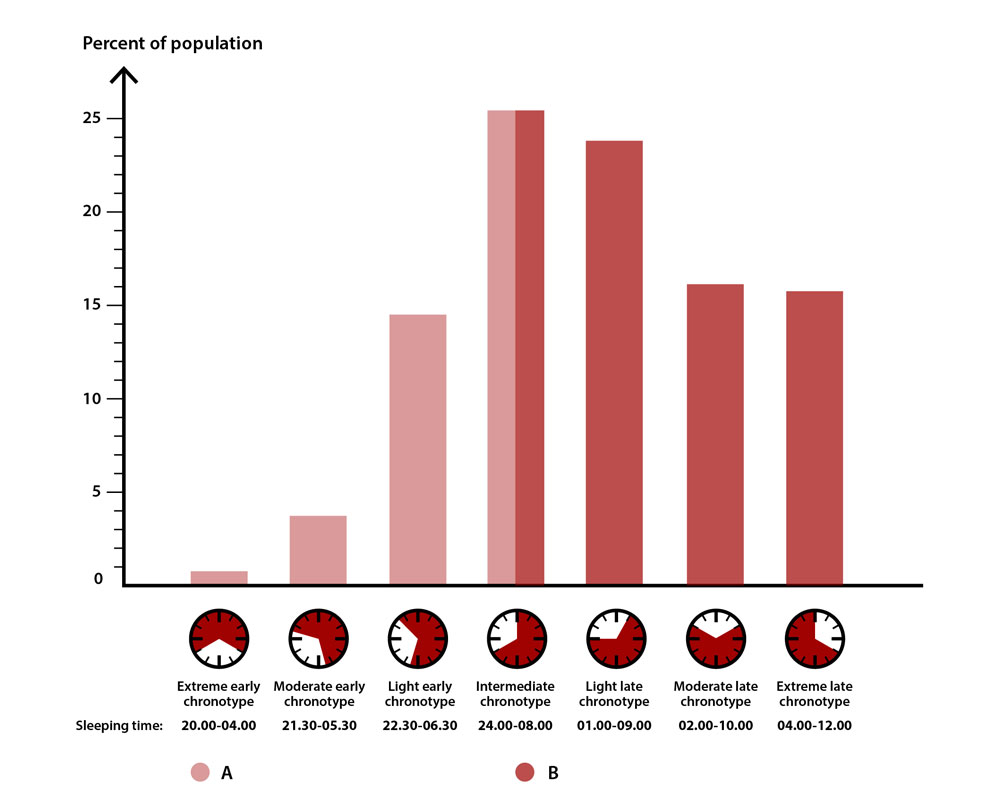
Even the early birds I knew didn't quite like the morning classes, because they then had to rush towards lecture halls first thing in the morning, rather than strolling leisurely to the library, eating breakfast, or jogging and taking a shower, which I suspect is what many early birds most enjoy about being an early bird.
The problem is that there are seminars and stuff that occur at at like 7 or 8 pm, so university life almost necessarily extends late (after lecture, dinner, assignments, projects) in the evening at least on some days. This is further exacerbated by the fact that given how many group assignments there are, individual student rarely have total control over their own schedule. Even if you carefully choose your classes, avoid all late-night sessions, don't party, plan your life, it's still incredibly hard to sleep before 11pm consistently.