All the other existing gas plants in France were built post 2010 for renewables.
> We are far from this as France is notoriously way behind, partly because it wastes money on nuclear late-and-overbudget projects (EPR...).
France spent more than a hundred billions on new renewables alone (roughly half of the total cost of the nuclear grid). It's true that the results look even worse than the EPR though. And it's not counting these new gas plants and external costs on the nuclear grid in the total.
The renewable investments look so bad that there's people like you who think they haven't been done but they have.
There's multille reasons France is bring the nuclear program back from the dead and one of them is that the renewable investments underdelivered.
> In France RTE is in charge of the grid (less the "last kilometer") and is a subsidiary of EDF (electricity producer, head of the nuclear sector.
RTE benefits from grid investments for renewables so yeah it's not a surprise they are all for it. They are especially afraid of a merge to go back to the previous statu quo.
Remember that big hole in the production on the graph before? That's exactly the time where the president of RTE made a public speech for building renewables, when they produced closed to nothing.
You wrote that "solar and wind" can drop "to 5% capacity for weeks at a time", and I ask for the source of this, in order to check that if, contrary to all scientific studies, it is true for a mix (wind, solar...) deployed on whole continent. Guess what? It isn't! Check "How synchronous is wind energy production among European countries?" (Monforti, Gaetani, Vignati). This is also true in China (check Liu, Xiao Wang, Dai, Qi "Analysis on the hourly spatiotemporal complementarities between China's solar and wind energy resources spreading in a wide area") and America ("Is it always windy somewhere? Occurrence of low-wind-power events over large areas" (Handschy, Rose, Apt).)
> Daunkelflaute
It's "Dunkelflaute" (only one 'a')
"a single event usually lasts up to 24 hours" and "more than two days over most of Europe happen about every five years" (source: https://en.wikipedia.org/wiki/Dunkelflaute ), here is for your "weeks at a time". Moreover regions outside North of Europe are way less impacted.
> are used for very low scale grid management
And what exactly forbids to manage all local grids this way? This is more and more true, as being able to isolate a local grid is useful.
> The only large scale tech to store electricity are dams
As of 2022, the total combined energy capacity of electric vehicle (EV) batteries sold in Europe reached approximately 690 GWh, and grows very quickly.
Note: dams are a renewable source.
> The only exisitng gas plant stil used before 2010
> As of 2022, the total combined energy capacity of electric vehicle (EV) batteries sold in Europe reached approximately 690 GWh, and grows very quickly.
Lol, so for context, a single French person is using 2.5GWh/year. One single inhabitant.
France is consuming 1.2TWh of electricity per DAY in winter.
So the whole electric vehicle fleet in the whole Europe is worth half a day (being generous) of electricity just in France during the time which is the tightest in electricity. That's so low it's not even worth mentioning. And that's the whole Europe compared to a single country, that's not going to make it.
> Note: dams are a renewable source.
There's also pretty much no new place where you can build one in a developped country as it's an old technology.
> You wrote that "solar and wind" can drop "to 5% capacity for weeks at a time", and I ask for the source of this
Solar produces most of it's production during 6 months and only gives 3% of the yearly production on each month of January and February. That's the two months where the countries are using the most electricity for context and need the most production.
For wind, that happens regularly, even right now as we speak, Germany has a 7% capacity which isn't far.
> deployed on whole continent. Guess what?
The wind production is synchronized right now, you can check it. That's another kind of strange of being shown the reality right now and denying it.
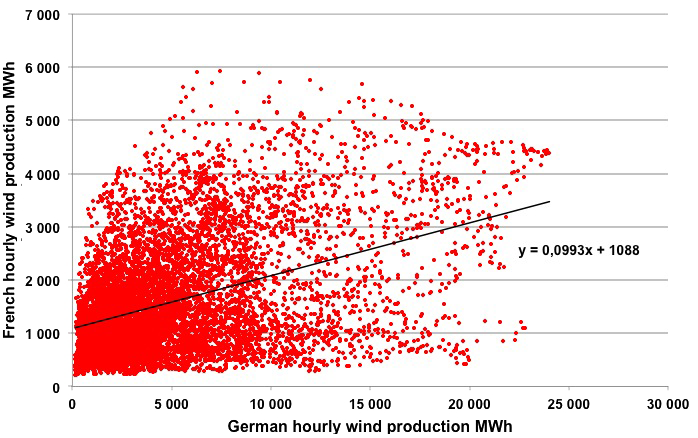
Here is the statistics, when it blows in Germany, it blows in France and when there's no wind in France, there's wind in Germany either.
> This is highly debatable as the real total cost of the nuclear fleet is disputed. Remember: EDF's debt now surpasses 50 billion €...
No it's not disputed, there's extensive reports in France on that subject as it's a common talking point.
I don't know any study about the external costs of renewables though so 100 billion for around 10% of the production is the best scenario. And calling it a failure seems pretty fair even with the most generous figures possible.
At the end of the day, the proof is in the pudding anyway, if it had worked, the nuclear program wouldn't have been brought back from the dead. France already tried ambitious renewable investments to replace the nuclear fleet during a whole decade and it failed. What the country got instead was mediocre results for the price paid and an increased dependency on gas which proved to be a huge issue with the Russian war. Those who don't learn from the past are condemn to repeat it.
Your document (Jancovici) analyzes current production of the very incomplete fleets of neighboring nations while the pertinent studies take into account wind regimes of geographic zones where wind turbines can be deployed and which are far appart. Conclusions of adequate scientific (J.-M. Jancovici expertise isn't about wind regimes) in reviewed and published studies (J.-M. Jancovici isn't) are quite different (please find some pointers in https://news.ycombinator.com/item?id=41397343 )
The last part of your answer is mostly devoid of sources, and I don't want to write about mere opinions.
> if it had worked, the nuclear program wouldn't have been brought back from the dead
> France already tried ambitious renewable investments to replace the nuclear fleet during a whole decade and it failed
Those industrial renewables are very new tech, they evolve very quickly, France missed its own objectives on renewables (sole nation in the UE to do so), France isn't rich anymore (during its nuclearization it benefited from the '30 Glorieuses' and from an intense and expensive R&D at home and in the US)...
https://sites.google.com/view/electricitedefrance/messmer-pl...
You completely forgot that there's companies using electricity and we live in a world where individuals are on the top of that electricity chain.
Your figures are completly wrong and do not include the whole electricity chain.
France produces close to 500TWh/year.
So yeah, I confirm what I said, the whole europan fleet of battery which you thought was impressive can only last half a day of a single country.
Also assuming that nobody want to use their car in Europe of course for that particular half day.
> Not true in some parts of Europe (North, esp Scandinavia, Balkans...)
That's not going to revolutionize anything, the biggest spots in the EU are already taken.
> Conclusions of adequate scientific (J.-M. Jancovici expertise isn't about wind regimes) in reviewed and published studies (J.-M. Jancovici isn't) are quite different
That's amamazing, you are plain denying reality, I'll do it once again, right now:
There you have it. The reality is in front of your eyes, the statistics confirm that the wind patterns are matching and even the real-time data that you refuse to look also does!
Sure there's some existing differences in some regions and some outliers but not nearly enough change the fact that relying on neighbors when the wind isn't blowing is a dead idea.
> Determining which project delivers a 'mediocre result' is easy.
Yeah sure it's easy, the new renewables took half the cost of the nuclear fleet for 10% of the production.
You can't put any lipstick on that sorry, you can try to tweak it the way you want, it's so bad that France had to restart its program back from the dead.
And those figures aren't even including the adaptations to the grid and the gas plants which I think they should.
> The French nuclear program was never killed. When was it killed, according to you, by who and how?
It was killed in 2012 by president Hollande and even written officially in the law in 2015 with a maximum of 50% nuclear production. The idea was to do maintenance while renewables took over. The nuclear program only got brought back from the dead in 2023, because of the Russian war and the failure of renewables to take over.
> You completely forgot that there's companies using electricity
Do you really believe that 'per capita' only takes into account electricity produced for industrial applications? It doesn't.
The subtitle ("Annual average electricity generation per person") seems clear to me.
Your "a single French person is using 2.5GWh/year" assertion is not backed up and clearly wrong. As the referenced graph ( https://ourworldindata.org/grapher/per-capita-electricity-ge... ) shows its around 8MWh/year (France is a net electricity exporter), which is more than 300 times more.
> France produces close to 500TWh/year.
Indeed.
France has approx 68 millions inhabitants.
Let's consider
(* 68M 8MWh): 544TWh
Bingo, I was right, isn't it? How much with 2.5GWh instead of 8MWh?
> The reality is in front of your eyes, the statistics
Don't you understand that in order to know if a continental 'renewable' mix will alleviate a fair part of the effect of 'intermittency' on production, we have to take into account all potential wind-turbine sites on the whole continent, NOT the very weak existing fleet (especially at the time of this document) of a few neighboring nations?
I won't answer to your mere opinions (assertions provided without any source).
According to you the French nuclear program was "killed in 2012 by president Hollande and even written officially in the law in 2015 with a maximum of 50% nuclear production."
This is complete BS: as showed in my previous answer everything ran as usual, this law didn't change anything. A law is not magically effective. What did it cause? The only theoretical effect of this law was the shutdown of the "Fessenheim" nuclear plant, the oldest one, exposed to seismic risk (Germany and Switzerland owned part of the plant and wanted it closed). This plant was only 2,8% of the fleet capacity!
Even at this date it would be moot because approximately 60% of France final energy is provided by fossil fuels, which have to be booted, implying a massive electrification and therefore a real need to produce more electricity... creating space for nuclear inside those 50%.


Source of what? That nuclear doesn't drop to 5%? It never happened so I can't get any source...
> I referenced proofs showing this is insufficient.
Well, it works in reality so the proof is in the pudding, it works.
> Nope. Source?
The Germans even have a word for that, Daunkelflaute
https://cdn.prod.website-files.com/65b3e159d25a6097b6ca5815/...
> Batteries already are ( https://www.nytimes.com/interactive/2024/05/07/climate/batte...
Well no they aren't, they are used for very low scale grid management, such as stated in your link.
> What do you mean? Electricity cannot be stored?!
No it can't in large scale, those battery needs to make a x100 here to be used for that. The only large scale tech to store electricity are dams.
> Brennilis (1981, 1981, 1996), Dirinon (1981), Gennevilliers (1991), Vaires-sur-Marne (2008, 2009), DK6 (2005)...
The only exisitng gas plant stil used before 2010 is DK6 and it's not even connected to the gas pipeline but reusing factory gas.
https://fr.m.wikipedia.org/wiki/Liste_des_centrales_thermiqu...
All the other existing gas plants in France were built post 2010 for renewables.
> We are far from this as France is notoriously way behind, partly because it wastes money on nuclear late-and-overbudget projects (EPR...).
France spent more than a hundred billions on new renewables alone (roughly half of the total cost of the nuclear grid). It's true that the results look even worse than the EPR though. And it's not counting these new gas plants and external costs on the nuclear grid in the total.
The renewable investments look so bad that there's people like you who think they haven't been done but they have.
There's multille reasons France is bring the nuclear program back from the dead and one of them is that the renewable investments underdelivered.
> In France RTE is in charge of the grid (less the "last kilometer") and is a subsidiary of EDF (electricity producer, head of the nuclear sector.
RTE benefits from grid investments for renewables so yeah it's not a surprise they are all for it. They are especially afraid of a merge to go back to the previous statu quo.
Remember that big hole in the production on the graph before? That's exactly the time where the president of RTE made a public speech for building renewables, when they produced closed to nothing.