Great work. I believe used M1/M2 machines will be favored by young developers as their personal fun laptop in a few years, like the Thinkpad T420 used to be. For different reasons, of course.
Do the M4 and M5 GPUs also change a lot from the M3? I hope it's not too much work to get those going once M3 is usable.
> I believe used M1/M2 machines will be favored by young developers as their personal fun laptop in a few years
I doubt it. For one, the SSDs have limited lifespans, and are soldered on the mainboard. They'll be fine enough for the planned life of the laptop, but eventually secondary market laptops will start seeing waves of failures, at which point people learn that purchasing one is a gamble.
The entire Apple silicon lineup is designed for limited lifespan.
SSD can be resoldered and that service is actually becoming popular and inexpensive. It's not just MacBooks, nearly all laptops have SSD and RAM soldered. This will become a totally normal thing in a few years from now.
Soldered storage is extremely uncommon for laptops not from Apple. You pretty much only find it in very low-end Chromebook type hardware that's using eMMC for cost reasons, and a small fraction of more expensive Qualcomm-based laptops that use UFS for no good reason. All mainstream PC laptops use M.2 NVMe storage.
> > It's not just MacBooks, nearly all laptops have SSD and RAM soldered
> That's simply a lie. No other laptop have soldered SSD. An increasing number do have soldered RAM.
That's simply a lie. Pretty much all laptops using eMMC or eUFS for storage are soldered directly to the mainboard. These are often budget devices and many are things like x86-based tablets or chromebooks but there are models that are very much laptops. I do concede I am unaware of any non-apple laptops with directly soldered NVMe storage, but your claim that no other laptop have soldered SSD is patently false.
I think it's a little disingenuous to try to compare high/er end Apple laptops with soldered storage to $2-300 Chromebooks and budget devices with soldered eMMC (which is much more like a CF/SD card than anything else) in your argument in the first place.
As you acknowledge. When you look at actual competitors to Apple, you're forced to acknowledge that yup, no other manufacturer solders storage.
But yes, with due pedantry, the statement that "no other laptop has a soldered SSD" is technically wrong.
You could get into additional debates on whether eMMC and eUFS would map to most people's understanding of "SSD", but...
Neither the ram nor the ssd is on chip. The ram is on package, the ssd is on board.
On chip means literally on top of the silicon, like how AMD X3D cpus mount the SRAM chip. On modern Apple devices the ram is mounted on the organic package substrate. The difference is significant, and it's shitty that Apple outright lied about it.
I think that particular definition of "on chip" is entirely your invention. I've usually seen it broadly used for anything on-package, whether it's on-die or on a separate die within the same package.
"On chip" definitely does not have much if any history of referring specifically to stacked dies with TSVs, because that has been a very niche packaging technique until recently, and "on chip" is a much more broadly used term.
It’s really a shame. May last “favorite” MacBook was from 2013 where everything was upgradable. I bought the fastest Core processor with the lowest everything else and upgraded to 16GB of RAM, SSD (granted at SATA speeds) and a second data drive in the optical drive bay. What luxury!
I've yet to see a desktop SSD wear out from writes. The only dead desktop SSDs I've seen have been due to buggy firmware (early drives or that recent batch of Samsungs) or well before their wear level is down (cheap noname drives off amazon).
My first SSDs were from Intel and I have completely worn them out by writing their specified maximum writable amount of data, in a couple of years or so.
After that, I have been careful to always buy only SSDs with the maximum amount of writable data that exist on the market. I have not worn out others yet, but those that have been used for many years show in their SMART counters that a large fraction of the permissible amount of written data has been reached and not much has remained until their end of life.
My point is the vast majority of desktop users do not write much. My experience is not just my own computers but the network of extended family and friends' small businesses I'm the informal tech support for. This includes video editors who edit large video files.
I do wear out SSDs but they're on servers I run with different use patterns.
Hah. Yes. Couple of drops of water on an an MBA... laptop worked fine. Battery, fine. Healthy. Charging circuit would not work. Perfectly functioning laptop on AC, but unable to be on battery because 0% charge.
Me, at Genius Bar, expecting you know, maybe $300 with parts and labor?
"Here's a quote, sir, we're looking at $850+tax, perhaps we should talk about getting you into a new Mac today?"
No. The laptop was primarily connected to AC anyway and only 18 months old, if that. Sorry, Apple.
Same here. Bought an Apple Keyboard a long time ago. Spilled some juice on it. Some keys stopped working. That's when I learnt that a $200+ Apple Keyboard isn't even water resistant unlike the previous $25-50+ keyboard I had. That was the first major red-flag about Apple I had. The soldered RAM and SSDs, and locked bootloaders on the Mac were the last straw. Will never purchase an Apple device again.
S**, I haven't felt much urge to upgrade from my 16GB M1 Air and I even use it to play some Windows games under Crossover. Quite possibly the best laptop I've ever owned.
It's always come in handy for containers/VMs (and I assume compiling Rust, as it uses as much of every other resource as it can get it's hands on) but yeah, being able to run actually useful local LLMs on my now >4 year old machine has been fantastic.
Public information seems to describe the M4 GPU as mostly a performance-oriented refresh of the one from M3. M5 has brought bigger changes, not least neural/tensor accelerators on chip.
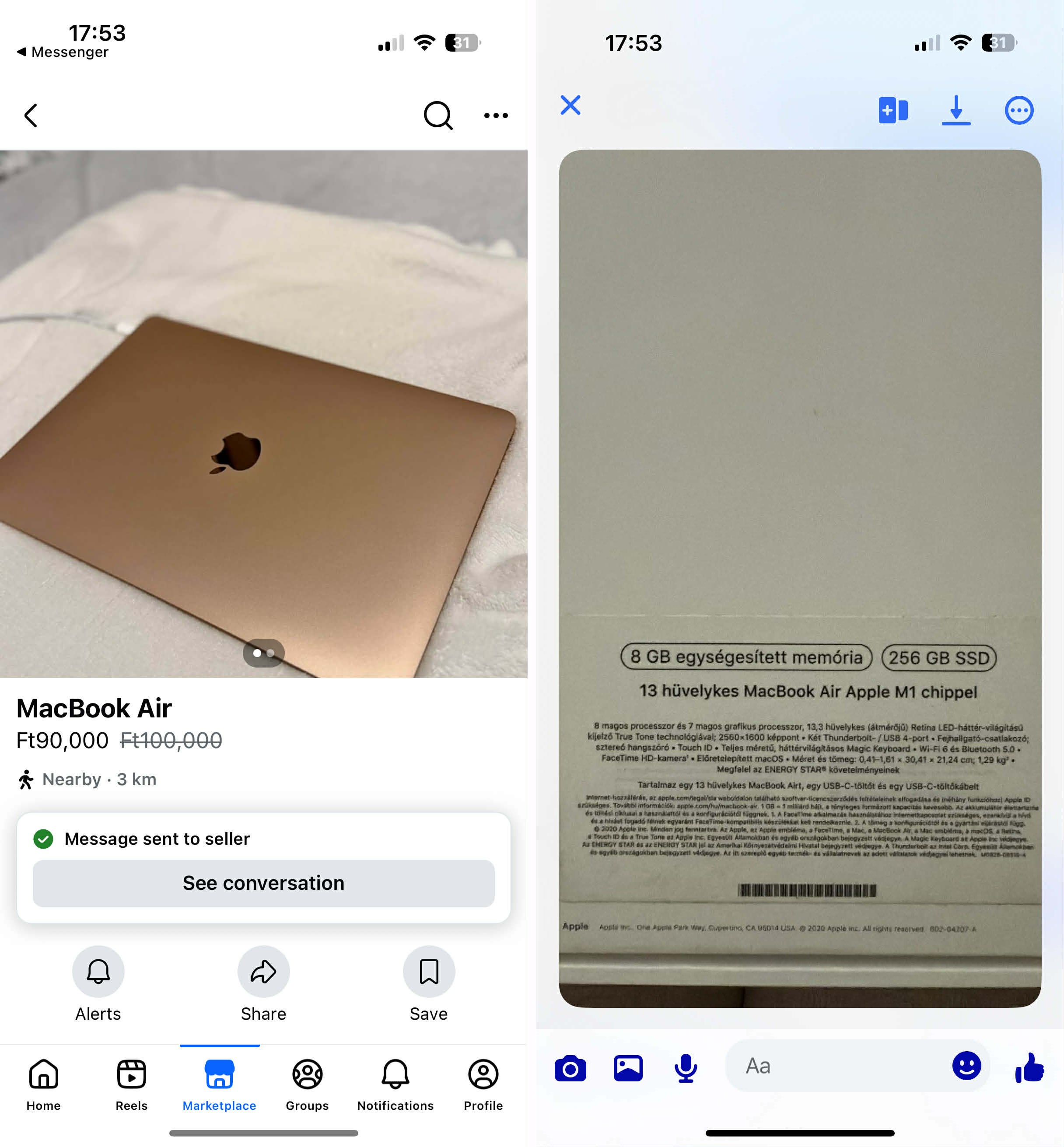
I just like the build quality and they are reaching the 200€ threshold on the used market. I bought one with 16GB RAM and a small black strip one the side of the screen (don’t bother me) for 230€ last week
>they are reaching the 200€ threshold on the used market.
Where?! I just cheeked the used market in Austria and 2020 M1s go for at least 350 for the 8GB RAM models and 450 for the 16GB model. Your 230 for the 16gb one fells more like a rare exception but not them norm everywhere.
Damn that's lucky. I checked facebook marketplace in Austria and prices are double that of what you're showing, even on Intel macbooks, there's no M1 macs for 200 Euros, only 400 Euros and up. Same on Vinted. No 200 Euro M1s, only at 2x the price.
The ones that I saw similarly low to yours are obvious scams from scam profiles all repeating the same message in the ad.
So maybe the ones you saw are scams as well. Otherwise hungary seems to be a lucky exception for some odd reason. Maybe because people have less disposable income, IDK?
Anyway, I wouldn't spend 400 Euros on a used mac with no warranty. The point of buying an old ThinkPad for cheap was that if something broke on it you could easily swap that part yourself for cheap because it was easily repairable and the used market was flooded with spare parts. But if your used macbook dies out of warranty, then you're shit out of luck, you can't fix anything, it's 400 Euros wasted.
I bought one already so I know it's not a scam. Scams usually communicate badly and they don't want to meet you in a public space (like a McDonald's with free wifi)
Obviously ymmv
>Anyway, I wouldn't spend 400 Euros on a used mac with no warranty.
This I agree with. I still prefer Thinkpads too but these M1s are also pretty good in almost every sense except for repairability
Apparently there's changes to boot that are more or less understood, but require some heavy work to handle.
Basically starting with M4 you have a choice between starting with Apple's page table monitor already running in their guarded mode extension, or all apple extensions disabled on the CPU cores.


Do the M4 and M5 GPUs also change a lot from the M3? I hope it's not too much work to get those going once M3 is usable.