> Can anybody counter Scalia, and say why the issue of gay marriage couldn't wait to be resolved by the states? Why is this class of license inequity different than other classes, where the states' right to license something is not resolved by SCOTUS?
Certainly with all the imagined legal expertise on HN, someone will answer. I have no expertise, but here's a shot at least from a moral point of view and based on some limited legal and political principles:
1) It can't wait because people are suffering now, today. Read Martin Luther King's 'Letter from a Birmingham Jail', where he points out that people who are not suffering always helpfully advise the oppressed to wait until later, 'until a more convenient time'. After I read that, I began to notice that pattern often.
2) We're not a democracy; we are, and this is essential, a constitutional democracy. Democracy is mob rule, or as someone said (Isaac Asimov?), 'democracy must be more than two wolves and a sheep voting on what's for dinner'. The Contitution, the Bill of Rights in particular, protects minority rights. It's not up to legislatures or the majority to grant or take away those rights. Civil rights are purposely excluded from the democratic process.
3) It's disingenuous to describe an issue of civil rights and the long-time oppression of millions as a dispute over licensing. Was segregation about hotel accommodations? Slavery and women's rights about employment disputes?
I think your third point is what's most striking about the dissenting opinion. Not providing marriage licenses to couples based on the arbitrary criteria of sex is a deliberate act of denying a specific group of people access to marriage.
The women's and civil rights movements went against the traditions of plenty of millennial old cultures such as the "Kalahari Bushmen and the Han Chinese, the Carthaginians
and the Aztecs"[0] as well.
> The women's and civil rights movements went against the traditions of plenty of millennial old cultures such as the "Kalahari Bushmen and the Han Chinese, the Carthaginians and the Aztecs"[0] as well.
Don't forget that liberal madness about replacing monarchs with elected government!
"The Union possessed features unique among contemporary states. Its political system was characterized by strict checks upon monarchical power. These checks were enacted by a legislature (sejm) controlled by the nobility (szlachta). This idiosyncratic system was a precursor to modern concepts of democracy, constitutional monarchy, and federation."
No, "minority" is correct here. Individuals who happen to be members of a majority do not need a Bill of Rights. Individuals who are a member of a minority do.
(edit: Holy cow this post got downvotes! If you think this is wrong please go read pretty much literally anything on the topic of the bill of rights by literally any of the founding fathers. Protecting the rights of democratic minorities was a very, very, VERY explicit goal of the bill of rights.)
"Democracy and liberty are often thought to be the same thing, but they are not. Democracy means that people ought to be able to vote for public officials in fair elections, and make most political decisions by majority rule. Liberty, on the other hand, means that even in a democracy, individuals have rights that no majority should be able to take away."
"Liberty, on the other hand, means that even in a democracy, individuals have rights that no majority should be able to take away."
"individuals have rights that no majority should be able to take away."
And yet, jrs235 is making an important point. The question is, which way does the causality run? Do individuals have rights because they're members of minorities, or do minorities have rights because they're composed of individuals? The correct answer, in my view, is the latter.
(Edit: Here is a summary of what happens below to save everyone time:
OP: 5 is a positive number.
jr: Correction: 5 is a number.
nm: That's a silly correction. It's more accurate to say it's a positive number, why are you correcting OP?
jr: But positive numbers are numbers!)
No, it is not an important point. It is a silly point that confuses the issue and is more wrong than right.
It is NOT accurate to say that it that the Constitution or Bill of Rights protects individual rights. They DO NOT protect individual rights. Instead, the Constitution provides for democratic self-governance bounded by some enumerated protections designed primarily to protect minorities. The hope was and is that these limited protections in tandem with democratic self-governance provide a system of government that will protect individual rights.
The Constitution and Bill of Rights is substantively and substantially different from a document that might enumerate a list of protected individual rights. Ensuring individual rights is the purpose and duty of the entire democratic process, not just the Constitution.
To make the point clearer, there are many items in the UN Declaration of Human Rights that the US recognizes (culturally) as being valid individual rights. E.g. The US provides universal access to education and the culture, on balance, recognizes access to secondary education as a fundamental right. But there is no constitutional prerogative for meeting this or other "rights" -- that's provided for legislatively. Georgia could defund its educational system tomorrow and the US Constitution wouldn't have squat to say about it.
In conclusion, the Constitution (edit)WAS NOT PRIMARILY DESIGNED TO PROTECT(/edit) individual rights. It protects primarily minority rights and provides for a system of governance that we hope will protect all individual rights.
(*edit, alternative wording for the paragraph above because jrs235 is nit-picking.)
> In conclusion, the Constitution does not protect individual rights. It protects primarily minority rights and provides for a system of governance that we hope will protect all individual rights.
The Constitution protects rights of individuals. It may not protect every agreed upon right. But the rights it protects belong to individuals (originally as drafted, those individuals were wealthy white land owners, not minorities like women or anyone else)!
The substance of my post above was that on balance, "minority rights" is a better characterization of the enumerated rights in the bill of rights than "individual rights".
Yes, saying "individual rights" isn't technically incorrect. But it's less accurate a protrayal than saying "minority rights".
Anyways, you're clearly ignoring the obvious intent of my posts in favor of stupid nit-picking. So I'm done.
The reason I press[ed] the issue of individual rights vs minority rights is because this quick summary gets read by others, assumed to be what matters, who then later don't believe that the rights belong to individuals, which gets repeated, which leads to the erosion of our individual rights.
>Ensuring individual rights is the purpose and duty of the entire democratic process, not just the Constitution.
And when the democratic process fails to protect individual rights, the Constitution, and more specifically the Bill of Rights, is the document that explicitly enumerates what the Government may absolutely not do.
May I ask where you received your education pertaining to the Constitution? And just to be certain (as I am currently assuming you are), are you an American?
> May I ask where you received your education pertaining to the Constitution?
From a constitutional law course taught by a professor with a JD from Harvard.
Again, rights of a minority are individual rights. But it's disingeneous to say that the constitution PROTECTS individual rights in general. It does not. It protects a small subset of individual rights that are most relevant when someone is in a political/racial/religious minority. Calling these rights minority rights is more accurate than calling them indvidual rights. In addition to minority rights, the consitutiton also provides a mechanism for ensuring other individual rights -- both de facto and de jure -- are protected.
Most of the founding fathers considered freedom from unreasonable taxation a plausible individual right. The Constitution doesn't provide explicit protections against that; instead, it provides self-governance.
Here is how I viewed this exchange:
OP: 5 is a positive number.
You: 5 is a number.
Me. That's stupid. It's more accurate to say it's a positive number, why are you correcting OP?
We typically call a person who disagrees with the majority a member of the minority.
> the majority
What majority? There are lots of majorities and lots of minorities -- one for each issue put forward to a group of citizens, and then a bunch of other cultural ones.
I doubt anyone is a member of each of those majorities. So yes, everyone needs these individual rights. But the rights were designed to protect individuals when they find themselves in the minority. So saying that the issue is individual rather than minority rights is disingenuous, confusing, and massively ahistorical. Again, many of these rights were explicitly designed to prevent violent mob rule. This issue is not up for debate. It is an historical fact. Go read what the founding fathers wrote about the Bill of rights.
What specifically can you point me to, what founding father, specifically wrote that the Bill of Rights was to protect minorities and not individuals?
I agree the founding fathers drafted the Constitution to prevent mob rule.
If a majority agrees we have freedom of speech, then we don't need the first amendment since it only protects minorities and minority opinions? The individual is the greatest minority, the Constitution protects individuals. Regardless of if an individual currently belongs to the/a majority or minority the Bill of Rights protects them.
EDIT: In other words, whether or not an individual is in the majority or minority opinion on an issue, the Bill of Rights protects the individuals to freely express their opinion. It's not as if an individual holds the majority opinion than they no longer get 1st Amendment protections. The rights belong to individuals not "minorities" (except in the sense that an individual is the greatest minority).
ADD: The founding fathers didn't care about minorities except themselves as individuals. They wrote the Bill of Rights to protect themselves individually.
See my response to ScottBurson. The Constitution does not protect individual rights in general. Instead, it protects a small set of individual rights that are most relevant when that individual finds himself in a minority, so-called minority rights.
It was expected that democratic self-governance would protect against other basic rights (e.g., to freedom from unreasonable taxation, the right to not be raped and murdered, etc.). But most individual rights are not listed in the Constitution, because the purpose of the constitution was to establish democratic self governance with protection for minorities against mob rule. NOT to provide for individual rights.
> What specifically can you point me to, what founding father, specifically wrote that the Bill of Rights was to protect minorities and not individuals?
Read Thomas Jefferson's First Inaugural Address, for starters.
Of course rights of minorities are individual rights, since minorities are composed of individuals. But the constitution was designed specifically to protect the rights of minorities, not to protect individual rights in general. The assumption was that democratic self-governance would provide for "little-r" rights; i.e., for fir and just governance.
Thomas Jefferson didn't say "I'm concerned about Sam and Henry over there... they might be in the minority on some opinion or issue in the future so I think we should draft a Bill of Rights to protect them." He probably thought, "I don't want to be screwed over by the majority. Perhaps I should draft some things to protect ME."
Because "ME" could be in the minority, whether by myself or 49.9% of the people.
Sure, they drafted rights to protect them in cases where they were minorities. Isn't that exactly what I'm saying?
I bet Jefferson didn't want to be raped. Wonder why he didn't make that an amendment? Could it have been because he figured that right could be provided in a non-constitutional setting?
I'm not saying they don't have those rights, I'm saying they don't need them. Not at the particular moment when they are expressing an idea that the governing party agrees with.
If you agree with a supermajority of Congress and the President on issue X, your first amendment rights to say you support issue X aren't really super important. Of course you should still have them, but they are easily protected by way of democratic processes -- constitutional provisions aren't necessary when the lawmakers are on your side.
>The Contitution, the Bill of Rights in particular, protects minority rights...
You are jumping to the consequences of the Constitution, the Bill of Rights in particular, protecting individual rights.
Because the Constitution, the Bill of Rights in particular, protects individual rights, minority rights are protected.
> constitutional provisions aren't necessary when the lawmakers are on your side.
Except when the lawmakers are in the minority (and you being in the majority), the majority still needs protections. Since its the individuals, not minorities that are protected, the rights of the [individuals in the] majority are also protected.
You're confusing the logical consequence with the historical reality.
The historical reality is that the rights enumerated in the amendments were designed specifically to protect minorities.
Yes, "individual rights are minority rights" implies "minotiries get rights". But if the primary purpose was individual rather than minority rights, then why in god's name aren't other more obvious individual rights (e.g., right not to be raped) enumerated as constitutional amendments? The answer is because the legislature can and will do that anyways.
Because with rape there is an obvious harm and injury incurred upon another. In suppressing speech or taking away arms, what is the explicit injury inflicted? What injury is inflicted in allowing government agents to enter your house whenever they want vs burglars? Because the protections enumerated in the Bill of Rights are difficult to argue that injuries and harm have been inflicted. The answer is because there is/was a legal framework that existed to deal with bona fide injuries and harm inflicted.
Legally, you are right. Morally and practically, I'm not so sure. Few hearts and minds are changed as a result of the supreme court's rulings, just the code powering the justice system. Convincing 5 of the top judges is easy compared to convincing the populace, and the latter is more important for the long term goals of equality.
Federally legislated social change pushes back the more important goals of social equality and cultural integration. These are arguably more important, as our interactions with marriage laws are a relatively minor part of our lives when compared to our interactions with other people.
The historical precedent here is clear, of course - there are no and have been no segregation laws in America for decades as a result of federal action, but you'd be silly to say that segregation does not exist in America.
> Today's decision pushes back the more important goals of social equality and cultural integration. ... there are no and have been no segregation laws in America for decades as a result of federal action, but you'd be silly to say the result was that segregation does not exist in America.
As a counterpoint: Since the civil rights era, the welfare and integration of the black-skinned Americans has improved dramatically. Some argue that desegregation alienated more hearts and minds than it helped, but I've yet to see any evidence. Certainly American opinions about blacks also have changed dramatically. (But I agree that we do have a long way to go.)
> No hearts and no minds are changed as a result of the supreme court rulings, just the code powering the justice system ...
I'm not sure no hearts and minds were changed -- I suspect many will reconsider, having seen the decision of a respected institution and the direction of society -- but I agree that you can't do that by court order. But there is a very substantive change: Gay Americans now can get married!
Good points. "Few hearts and minds" is more accurate.
> Some argue that desegregation alienated more hearts and minds than it helped, but I've yet to see any evidence.
It's a question that isn't easy to answer empirically, but it's not outside of the realm of possibility that we would today have a less segregated of a society if segregation had come been eradicated in each community separately and via local and state laws rather than federal action.
All that aside, I think legal equality is a worthy cause and a great victory on its own. I hope we do not forget about social equality and cultural integration as worthy causes, as well.
> No hearts and no minds are changed as a result of the supreme court rulings, just the code powering the justice system.
A lot of the "hearts and minds" you talk about are animated by "tradition", which is often code for "continuing to do the thing I grew up with". The legal code changes what people grow up with, thereby changing future hearts and minds.
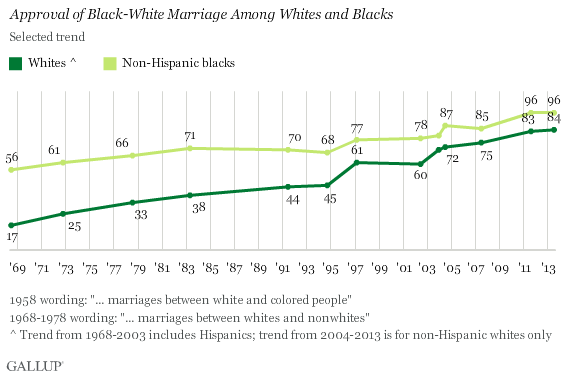
Take a look at the graph of approval rates of interracial marriage:
Some of the change there is changing hearts and minds. But a lot of it is just the replacement of bigoted hearts and minds with new ones.
As Max Planck wrote, "A new scientific truth does not triumph by convincing its opponents and making them see the light, but rather because its opponents eventually die, and a new generation grows up that is familiar with it."
And if that's true for science, it's much more so for cultural things like this. I think there's little point in continuing to harm GLBT families in the hopes of preserving the delicate feelings of people who were unlikely to change anyhow.
On the flip side, SCOTUS rulings have the power to accelerate trends already happening in society. Making segregation in schools and in housing illegal does not eliminate racism. But it does lead to a generation of people that aren't raised in schools and neighborhoods that only have people of one race.
> Today's decision pushes back the more important goals of social equality and cultural integration. These are arguably more important, as our interactions with marriage laws are a relatively minor part of our lives when compared to our interactions with people.
We've proven as a society that this won't happen without administrative action being taken from the top.
The legality has real consequences for people right this second, so waiting for the tide of change is absurd to ask of those that are affected.
Both fronts can be attacked simultaneously.
Though, I do agree there is a trend to pass a stopgap measure and to then pretend the problem is fixed.
This is a logically-consistent line of thought that---inconveniently---doesn't seem to align with evidence.
Historically, it seems to be the case that when society legalizes something, and people can observe that under that new order, society doesn't crumble, societal attitudes on the morality of that thing change to reflect the reality (albeit slowly).
Consider women's suffrage. Consider no-fault divorce. Consider black men and white men being forced to serve side-by-side in WWII by the draft, then coming home to a country that still treated them unequal in the eyes of the law.
It's not a 100% consistent scenario (contrast abortion rights debate in the wake of Roe v. Wade), but the trend is for culture to adapt in the face of evidence.
No hearts and no minds are changed as a result of the supreme court rulings, just the code powering the justice system.
This assumes that peoples' moral judgments aren't influenced by societal opinion and that societal opinion isn't influenced by laws and the opinions of its leaders/elites. That seems like a tough case to make.
Today's decision pushes back the more important goals of social equality and cultural integration.
Hearts and minds are more easily influenced by the status quo than one might think. People whose opposition wasn't obsessive tend to take note of the fact that they know some friends of friends who had one of those gay marriages and they're apparently very happy, whilst their pastor who gave such eloquent warnings about the impending moral breakdown of America whilst the anti-gay-marriage ballot initiatives were being drawn initiatives has changed the subject of his moral crusade to something else, and above all it doesn't really doesn't seem worth revisiting the issue or worrying about homosexuals at all when they could be mobilizing to save unborn babies, their constitutional right to lethal weaponry or the immortal soul of their atheist nephew. When change is less drastic than you feared, it becomes easier to accept than you anticipated.
Sometimes an upvote isn't enough. This is probably the most thoughtful writing I've seen on the topic today. Well done for someone that is not an expert. :-)


Certainly with all the imagined legal expertise on HN, someone will answer. I have no expertise, but here's a shot at least from a moral point of view and based on some limited legal and political principles:
1) It can't wait because people are suffering now, today. Read Martin Luther King's 'Letter from a Birmingham Jail', where he points out that people who are not suffering always helpfully advise the oppressed to wait until later, 'until a more convenient time'. After I read that, I began to notice that pattern often.
2) We're not a democracy; we are, and this is essential, a constitutional democracy. Democracy is mob rule, or as someone said (Isaac Asimov?), 'democracy must be more than two wolves and a sheep voting on what's for dinner'. The Contitution, the Bill of Rights in particular, protects minority rights. It's not up to legislatures or the majority to grant or take away those rights. Civil rights are purposely excluded from the democratic process.
3) It's disingenuous to describe an issue of civil rights and the long-time oppression of millions as a dispute over licensing. Was segregation about hotel accommodations? Slavery and women's rights about employment disputes?